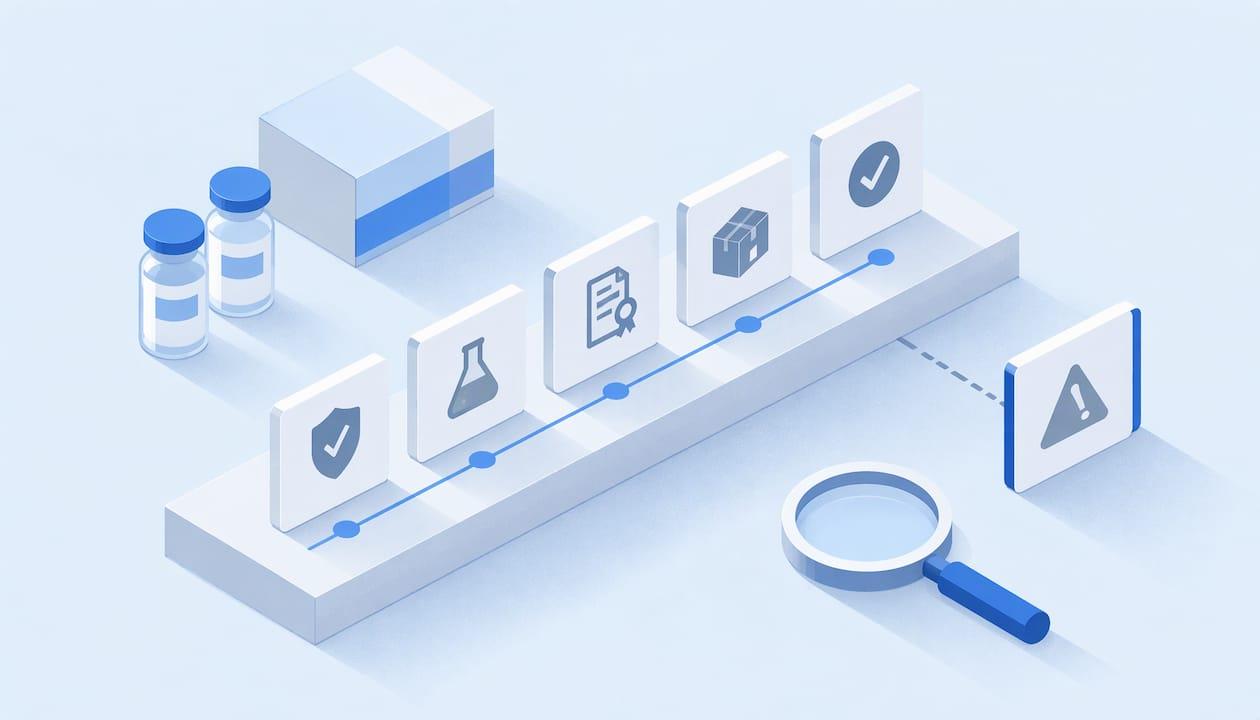
You avoid peptide scams by checking three things before you send money: who the seller really is, whether independent lab paperwork exists for the exact batch, and whether the payment method gives you any way to get your money back. A seller who fails any one of these is not worth the risk, however good the price looks. Below are the warning signs, a step-by-step way to verify a vendor, the health risks of bad product, and what to do if you have already paid.
TL;DR
- Walk away from sellers that accept only crypto, wire transfers or gift cards, hide their address, or push you to WhatsApp or Telegram.
- A real certificate of analysis names the lab, the batch and the method, and includes the chromatogram. A screenshot with a purity number proves little.
- Check every report on the issuing lab's own website, never through a link the seller gives you.
- Fake or contaminated vials have put people in the hospital. Unapproved injectables carry real infection and liver risks.
- Paid already? Contact your bank or card issuer right away and report it to the FTC.
Table of Contents
- Why peptide scams are so common
- Nine checks before you pay
- How to read a certificate of analysis
- Why a scam is more than lost money
- Research-use labels and the law
- Perspective: why the paperwork is the product
- Check before you buy, with lab records
- If you already paid or suspect a scam
- If you run a peptide business
- FAQ
- Sources
Why peptide scams are so common
Peptides are sold in a gray zone. Many compounds are marketed as "research use only," the vials look alike, and a buyer cannot tell by eye whether a vial holds the right compound, a filler or something else. That is why scam reports follow a familiar pattern: a buyer receives vials of white powder with no active peptide in them, and has no recourse.
The Los Angeles Times describes the same problem from the medical side. Illegitimate vendors often have no verifiable physical address, and buyers have no recourse because they do not know where the product is coming from. The reporting also lists cryptocurrency-only payment, missing third-party testing documents and prices far below what a licensed compounding pharmacy would charge as common warning signs.
Our own work starts from the same problem. We compile and analyze data from 12,423 independent lab tests across 481 peptide vendors, so we see how wide the gap between vendors can be. The checks below are the ones we would run ourselves.

Nine checks before you pay
1. Look at how they want to be paid
Hard-to-reverse payments are the classic scam signal. The FTC says that if you paid a scammer, your money might already be gone, but it is worth asking the company you paid through whether it can be returned. Wire transfers, gift cards and crypto make that much harder than a credit card does. A shop that offers only these methods has chosen a payment route where you cannot dispute a charge.
2. Confirm a real business exists
Search the listed address. Does a building exist there? Is there a working phone number, a named company and a support inbox that answers a plain question? A brand-new site with no business details, countdown timers and urgent "last stock" banners deserves extra suspicion. Lookalike sites that copy the name of a vendor that has closed are another trap. Our list of closed peptide vendors shows shops that shut down or went offline, so you can recognize a name being reused.
3. Be wary of messaging apps and unsolicited offers
If a "supplier" contacts you first, or moves you straight to WhatsApp or Telegram, stop. Reputable shops have a store, a checkout and written policies. Influencer codes and DMs are not a substitute for any of those.
4. Treat a price far below the market as a warning
Cost matters, but a price that is a fraction of everything else usually means the vial holds less than the label says, or nothing at all. Compare against a market baseline first. Our peptide price list shows cost per milligram for each peptide, so you can see what a normal range looks like before judging any single offer.
5. Ask for the full certificate of analysis
No certificate, or a certificate that is only a cropped image, is a red flag. Ask for the full report for the batch you are buying. The next section explains what it should contain.
6. Verify the lab, not just the document
A forged or reused report looks the same as a real one. Find the laboratory's official website yourself, then check the report number or QR code there. Confirm the compound, batch, test date and result match what the seller claims. Be careful with links or QR codes that go to a page the seller controls.
7. Look for batch or lot numbers on the vial
A certificate is only useful if you can tie it to what you hold. A vial with no lot number cannot be matched to any report. If the number on the vial does not appear on the document, the document tells you nothing about your purchase.
8. Check the reviews you cannot easily corroborate
Glowing testimonials on the seller's own site, or in forum threads that appear overnight, prove little. Independent lab records are harder to fake than opinions. Our vendor list grades every shop on lab tests only, and each score links to the original lab certificates.
9. Pay in a way that gives you recourse
Where a vendor is legitimate and offers a credit card option, use it. Card networks offer dispute processes that wire transfers and gift cards simply do not. Keep the order confirmation, the listing page and all messages.
How to read a certificate of analysis
A certificate of analysis (CoA) is the document that is supposed to prove what is in the vial. A weak one is easy to produce, so know what a proper one contains.
The World Health Organization publishes a model certificate. It calls for the issuing laboratory's name and address, a CoA identification number, the batch number, the manufacturer, the test procedures used, all results, a conclusion on whether the sample meets specification, and a dated signature from an authorized person. That is a pharmaceutical standard, and research-peptide reports rarely match it fully, but it gives you the yardstick.
For a peptide, a useful report typically shows:
| What to look for | Why it matters |
|---|---|
| Named laboratory with contact details | Lets you contact the lab and confirm the report is genuine |
| Batch or lot number | Ties the report to the vial you receive |
| Compound name and expected molecular weight | Confirms the right peptide, not just a high number |
| HPLC purity with the chromatogram | A purity percentage with no trace behind it is just a claim |
| Mass spectrometry result | Confirms identity by mass |
| Test date | Shows the test is recent and not recycled from an old batch |
| Verification method (report number, QR code, link) | Lets you check it on the lab's own site |
Two more points. First, a lab that has a business relationship with the seller is less useful than an independent one. Second, a report on one batch says nothing about the next, so repeat orders need repeat checking. We explain how we apply this in our grading rubric, and our seven-check guide to verifying a vendor walks through the process in order.
Why a scam is more than lost money
Peptides are usually injected, which turns a bad vial into a medical problem as well as a financial one.
New Zealand's medicines regulator Medsafe warns that unapproved peptide products may be poor quality, may not contain the substance on the label, may contain other harmful substances, or may not be sterile. Because they are injected, it adds, the risk of life-threatening infection is high.
In Australia, seven Victorian patients were hospitalized with acute liver toxicity after using a counterfeit of the weight loss peptide retatrutide, according to ABC News. A liver transplant specialist said the injuries appeared within a few weeks. Testing of a counterfeit batch reported by The Pink Times found doses from 40 to 190 percent of the label claim, and one vial marked 10 mg held 19 mg at 16.6 percent purity. Those numbers show why a purity claim must come from an independent lab and not from the seller.

If you use any peptide, talk to a physician or pharmacist first, especially if you take other medications, are pregnant or have liver, kidney or immune conditions. Seek urgent care if you develop fever, spreading redness or swelling at an injection site, yellowing of the skin or eyes, or severe abdominal pain after an injection.
Research-use labels and the law
A "for research use only" label does not make a compound approved for people. Health Canada states plainly that products labeled research use only are not authorized for human use and the label does not make them legal to import or sell in Canada. Rules differ by country, and so do consequences for buyers. In the US, whether a product is treated as a drug turns largely on its intended use. Check the rules where you live, and confirm with a pharmacist or physician before using anything on yourself.
The label also matters as a scam signal. Coded product names and vague descriptions are used to avoid scrutiny, and legitimate sellers do not need them.
Perspective: why the paperwork is the product
We started Peptide Vendor Reviews because the usual advice, "read the reviews," fails in this market. Reviews are cheap to fake. A certificate of analysis tied to a batch, issued by a lab that does not work for the seller, is not.
That is why we grade vendors only on independent lab tests and never on paid submissions or vendor marketing. Every score links to the original lab certificates, so you do not have to trust us, you can read the record. Advertising and affiliate relationships do not change a grade.
Our advice to any buyer is simple. Judge a shop by its records, compare it with others on the same measures, and make a decision from evidence. A vendor with a solid lab history has nothing to hide from a careful buyer. That is the standard we hold the whole market to.
Ross
Check before you buy, with lab records
If you want to skip the guesswork, start from the evidence. Our vendor directory grades every shop on its independent lab tests. You can check purity by compound on the peptide purity page, and compare cost per milligram on the price pages. Each score links to the original lab certificate behind it.

If you want a vial you already own checked independently, the sample testing page explains how our testing information works. Our reviews are not paid placements. We earn a commission when readers buy from linked vendors, and that never changes a grade.
If you already paid or suspect a scam
Act quickly. The steps below follow the FTC's guidance.
- Contact the payment provider at once. For a debit or credit card, call your bank or card issuer, using the number on the card, and ask for a refund or dispute. For a wire transfer, report it to the wire company immediately and ask for a refund. For a gift card, contact the issuer.
- Stop paying. Any "fee" to release an order, clear customs or recover your money is a second scam.
- Keep records. Save screenshots of the listing, the order email, the payment receipt and every message.
- Report it. File a report with the FTC at ReportFraud.ftc.gov, and tell the platform where you found the seller.
- Do not use what you received. If the vials arrived and you have doubts, do not inject them. If you already used them and feel unwell, contact a physician or poison control (1-800-222-1222 in the US).
- Watch for recovery scams. Anyone offering to get your money back for an upfront fee is likely running another one.
If you run a peptide business
Vendors who want to be trusted can make verification easy for buyers. Publish full reports, not screenshots. Name the independent lab and give a way to confirm the report on the lab's own site. Put batch numbers on vials and match them to the report. Use plain product names and show a real business address and contact. Repeat testing on every new batch. These steps are what a careful buyer looks for, and lab records speak louder than marketing copy.
FAQ
What is the biggest red flag when buying peptides online?
A payment method you cannot reverse is the biggest one, usually crypto, wire transfer or gift cards only. Close behind are no verifiable address and no independent lab report for the batch. Any two together are a reason to walk away.
Can I trust a certificate of analysis from the seller?
Only after you check it. Confirm it names a lab, shows the batch number, includes the chromatogram and mass spectrometry data, and can be verified on the lab's own website. A purity percentage on its own is a claim, not proof.
Are peptides sold as "research use only" safe for human use?
No. That label means the compound has not been approved for human use, and regulators such as Health Canada say it does not make a product legal to import or sell. Talk to a physician or pharmacist before using any peptide, and check the laws where you live.
What should I do if I sent money to a fake peptide seller?
Contact your bank, card issuer or wire company immediately and ask for a refund. Stop sending any further payments, keep your records and report it to the FTC. If you already used a product and feel unwell, seek medical care.
How do I find vendors with real lab results?
Look for shops with independent, batch-specific reports that you can confirm on the lab's own site. Our vendor reviews grade shops only on lab tests and link each score to the certificates.
Sources
- Buying Peptides Online? Here's How to Spot Fake and Unsafe Products, Los Angeles Times
- What To Do if You Were Scammed, FTC
- WHO model certificate of analysis, TRS 1010 Annex 4
- Consumer advisory: Unapproved peptide products, Medsafe New Zealand
- Doctors fear possible contaminated counterfeit peptide, ABC News
- Australia warns over counterfeit peptides after Victoria hospitalisations, The Pink Times
- Peptides: Research and clinical trials, Health Canada