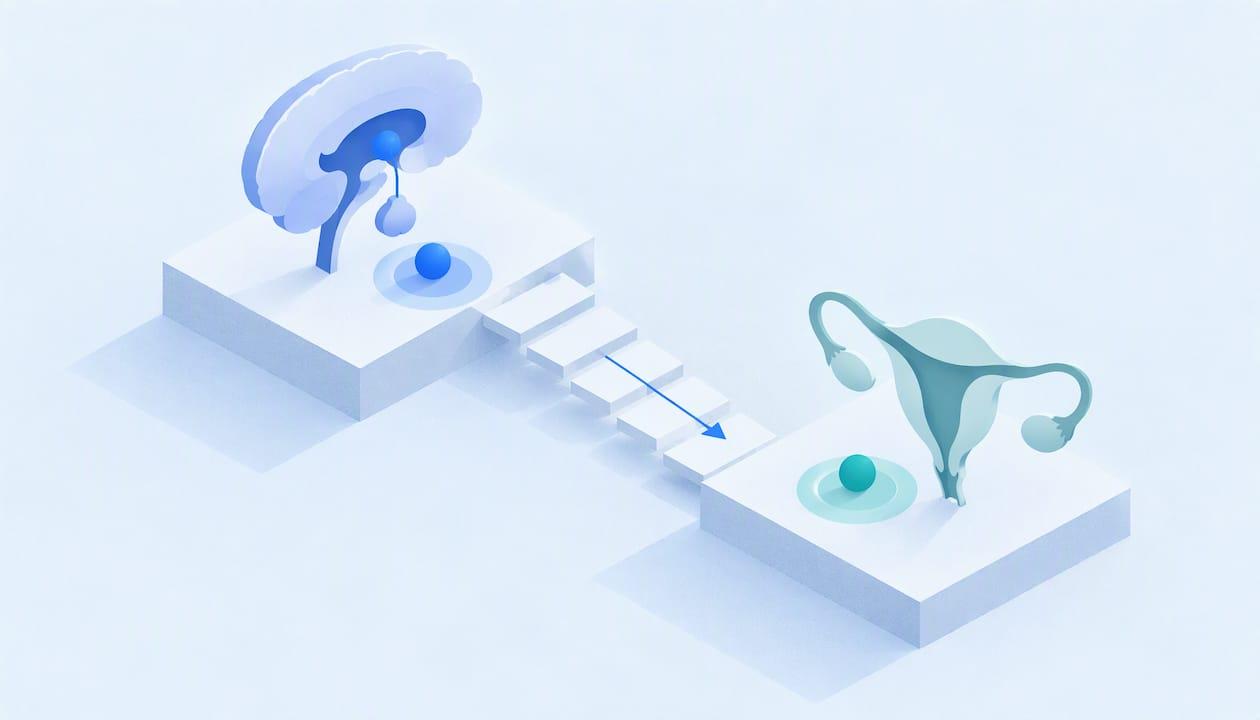
Kisspeptin-10 and gonadorelin both end up raising luteinizing hormone (LH) and follicle-stimulating hormone (FSH), but they work at different steps. Kisspeptin-10 acts higher up, on the brain neurons that release gonadotropin-releasing hormone (GnRH). Gonadorelin is a copy of GnRH itself and acts one step lower, on the pituitary. That single difference explains most of what readers ask: which one is stronger, which needs a working upstream system, and why neither is a simple swap for the other.
This guide explains the pathway, compares the two peptides side by side, and covers what human studies show, the regulatory picture in the US, and how to check the quality of any research peptide before you trust it.
TL;DR
- Kisspeptin-10 stimulates GnRH neurons to release your own GnRH. Gonadorelin is synthetic GnRH and stimulates the pituitary directly.
- In a head-to-head study in healthy men, GnRH stimulated gonadotropin secretion more potently than kisspeptin at the doses tested.
- Human data for kisspeptin-10 is mostly short, small, controlled studies. Gonadorelin has established use in congenital hypogonadotropic hypogonadism, but its use alongside testosterone therapy is an extrapolation.
- Neither peptide should be treated as a casual supplement. Talk to an endocrinologist or urologist before using either for a health goal.
- For any peptide you buy for research, a batch-specific certificate with both HPLC purity and mass spectrometry identity is the minimum to ask for.
Table of Contents
- Where each peptide sits in the hormone chain
- What the human evidence shows
- Can kisspeptin be used with hCG or gonadorelin?
- Kisspeptin and puberty
- Regulatory status in the United States
- Delivery routes and open questions
- Who should be cautious
- Perspective: why quality data matters more than the label
- How to check a peptide before you trust it
- Comparing vendors and prices
- FAQ
- Sources
Where each peptide sits in the hormone chain
The reproductive axis is a relay. The hypothalamus releases GnRH in pulses. GnRH tells the pituitary to release LH and FSH. LH and FSH then act on the testes or ovaries to drive sex hormone production and gamete development. This is often called the HPG axis (hypothalamic-pituitary-gonadal).

Kisspeptin-10: the upstream trigger
The KISS1 gene is processed into several kisspeptin peptides. According to a 2025 review in Physiological Reviews, all native forms share a C-terminal decapeptide, and the amidated RF-amide end is required for strong receptor activation. Kisspeptin-10 is that shortest active fragment.
The same review describes how kisspeptin-10 binds the kisspeptin receptor (KISS1R, also called GPR54) on hypothalamic GnRH neurons, depolarizes them and promotes release of endogenous GnRH. In other words, it needs your own GnRH neurons and pituitary to be intact and responsive. It nudges the system rather than replacing a missing signal.
Gonadorelin: synthetic GnRH
The NCATS drug record describes gonadorelin as a synthetic decapeptide that works as GnRH does, releasing LH and FSH from the anterior pituitary. It is used to mimic the physiologic release of GnRH. Because it acts at the pituitary GnRH receptor, it does not depend on kisspeptin neurons being active.
The practical consequence
| Kisspeptin-10 | Gonadorelin | |
|---|---|---|
| What it is | Fragment of a natural neuropeptide | Synthetic copy of GnRH |
| Site of action | GnRH neurons in the hypothalamus | GnRH receptors on the pituitary |
| Mechanism | Triggers your own GnRH release | Directly stimulates LH and FSH release |
| Needs functioning GnRH neurons | Yes | No |
| Typical research context | Reproductive neuroendocrinology, puberty, fertility signaling | Diagnostic testing, pulsatile therapy for hypogonadotropic hypogonadism |
What the human evidence shows
Kisspeptin-10 in men
Kisspeptin-10 has a reasonably consistent short-term effect in men. A review of the kisspeptin-GnRH pathway notes that both intravenous and subcutaneous kisspeptin-10 reliably stimulate LH and, to a lesser extent, FSH. The first-in-human work, published in the Journal of Clinical Endocrinology and Metabolism, found that kisspeptin-10 is a potent stimulator of LH and increases pulse frequency in men.
Those are acute hormone responses in small groups. They show that the pathway can be activated. They do not show that taking kisspeptin-10 over weeks improves symptoms, fertility or body composition.
Kisspeptin-10 in women
Women respond differently, and timing matters. A study of kisspeptin-10 and reproductive hormones found that intravenous kisspeptin-10 raised LH and FSH in healthy men and in women in the preovulatory phase, but not in women in the follicular phase. Subcutaneous bolus injection and intravenous infusion also failed to raise reproductive hormones in follicular-phase women. Anyone reading a generic claim that kisspeptin "works the same for everyone" should treat it with suspicion.
Head-to-head: which one is stronger?
A direct comparison in healthy men found that GnRH stimulated gonadotropin secretion more potently than either kisspeptin isoform at the doses tested. That fits the biology: kisspeptin is a trigger for GnRH release, while GnRH is the signal the pituitary reads directly. Potency is not the only consideration, though. Kisspeptin works through the body's own pulse generator, which is why researchers study it for signaling and regulation rather than only for raw hormone output.
Gonadorelin and testosterone
Does gonadorelin raise testosterone? Indirectly, yes. It stimulates LH, and LH tells the testes to make testosterone. In a person whose pituitary and testes work normally, that is the logic. In practice, how it is dosed matters a great deal. Natural GnRH is released in pulses, and the pulsatile pattern is what established therapy for congenital hypogonadotropic hypogonadism (CHH) relies on.
The popular use of gonadorelin alongside testosterone replacement therapy, to keep the testes active, is a different matter. One evidence review states that this use is an extrapolation from CHH data and that no randomized controlled trials support the specific indication. If a forum post or social media thread presents it as proven, that is stronger than the data allows.

Can kisspeptin be used with hCG or gonadorelin?
This is a common question, and the honest answer is that there is no good human trial data to guide combinations. The three compounds act in different places: hCG mimics LH at the gonad, gonadorelin acts at the pituitary, and kisspeptin acts at the hypothalamus. Stacking them might look logical on a diagram, but a diagram is not a dosing study. Combining agents that act on the same axis can blunt or distort the natural pulsatile signal. Any physician managing fertility or low testosterone can explain which single approach fits a specific diagnosis, and that conversation matters more than a protocol found online.
Kisspeptin and puberty
Kisspeptin is one of the main signals that reactivates the HPG axis at puberty. The Physiological Reviews article links loss-of-function variants in the kisspeptin pathway with delayed or absent puberty, and gain-of-function variants with central precocious puberty. This is the strongest evidence that kisspeptin sits near the top of the chain. It is also why researchers see it as a target for treating reproductive disorders, rather than just a hormone booster.
Regulatory status in the United States
Neither peptide is something to buy casually as a supplement.
For kisspeptin-10, an FDA briefing document prepared for the Pharmacy Compounding Advisory Committee states that kisspeptin-10 is not a component of an FDA-approved drug and has no USP or NF monograph. The document evaluates kisspeptin-10 for inclusion on the 503A bulk drug substances list, with secondary hypogonadism in men as the condition considered. Being evaluated is not the same as being approved.
Gonadorelin has a longer clinical history, and the NCATS record lists it under the name gonadorelin acetate. Product availability in the US has changed over time, and finished products have been discontinued, so verify the current status on the FDA's own drug databases rather than relying on a vendor's description.
Athletes should also know that gonadorelin appears in anti-doping guidance. Check the current World Anti-Doping Agency Prohibited List if you compete in tested sports.
Delivery routes and open questions
Most kisspeptin research has used injections. Newer work asks whether a gentler route could work. A 2025 study in eBioMedicine reports that intranasal kisspeptin rapidly stimulates reproductive hormones, and the authors frame it as a potential non-invasive approach that may overcome the acceptability limits of injected forms. That is promising, but it is early evidence in a research setting, not a ready-made home protocol.
Other open questions include long-term safety, the right dose and interval for each goal, how responses differ by sex and cycle phase, and whether repeated kisspeptin exposure reduces responsiveness. Anyone who tells you these are settled is selling something.
Who should be cautious
- Men on testosterone therapy who want to preserve fertility or testicular size: ask your prescribing physician or a urologist about options with trial support, such as established treatments for the specific goal.
- Women with irregular cycles or suspected PCOS: kisspeptin responses vary by cycle phase, so self-experimenting can produce no effect or an unpredictable one. A reproductive endocrinologist can run the right bloodwork first.
- Parents of children with early or late puberty: this is a pediatric endocrinology question and never a case for experimental peptides.
- Competitive athletes: check anti-doping rules before any use.
Perspective: why quality data matters more than the label
We review peptide vendors, we do not sell peptides, and we do not give medical advice. What we do see, across thousands of lab results, is that the name on a vial tells you very little. Two products both labeled kisspeptin-10 can differ in purity, in whether the main peak is really the right molecule, and in how much peptide the vial holds.
That matters most for peptides like these, where the research already carries uncertainty about dose and response. If the material is off, you cannot tell whether a result reflects the biology or the product. Our view is simple: treat a vendor's claim as a hypothesis, and treat an independent lab record as the test. Choose a source because its batches were tested by someone other than the seller, not because its page looks professional.
— Ross
How to check a peptide before you trust it
A certificate of analysis (COA) is a starting point, not proof. Here is a practical way to read one.
- Batch specificity. The COA should carry a batch or lot number matching your vial. A generic certificate reused across batches tells you nothing about yours.
- Purity by HPLC. High-performance liquid chromatography estimates the share of the main peak. It does not confirm what that peak is.
- Identity by mass spectrometry. The measured mass should match the expected mass of the peptide. One industry analysis argues that orthogonal testing is needed because a single HPLC result is not enough, and that identity confirmation by mass spectrometry should accompany purity by HPLC.
- Who ran the test. A lab the seller does not control is worth far more than one the seller pays and chooses.
- Quantity. Purity is a percentage. It does not tell you how many milligrams of peptide are in the vial, so look for content testing too.
- Traceability. You should be able to trace the number back to an original lab document, not a screenshot.
We lay out the full checklist in how to verify a peptide vendor, and show how results look across compounds on our peptide purity page. If you want to test a vial yourself, our sample testing information explains how.
Comparing vendors and prices
If you have decided to source a research peptide, compare on evidence first and price second. Our methodology grades vendors solely on independent lab tests, never on paid submissions or vendor marketing, and every score links to the original lab certificates. Our rankings are not influenced by advertising or affiliate partnerships.
The platform compiles 12,423 independent lab tests across 481 vendors. You can browse the full vendor list graded by lab tests, then compare cost per milligram on the peptide price list. We earn commissions when readers buy through links to vendors, but that does not change a grade.

Start at the Peptide Vendor Reviews home page to search a vendor by name and see its lab record before you order.
FAQ
What is the difference between kisspeptin-10 and gonadorelin?
Kisspeptin-10 acts on hypothalamic neurons and prompts your own body to release GnRH. Gonadorelin is synthetic GnRH and acts directly on the pituitary. Kisspeptin therefore depends on functioning GnRH neurons, while gonadorelin bypasses them.
Does gonadorelin raise testosterone?
It stimulates LH and FSH, and LH drives testosterone production in the testes. Its established clinical use is pulsatile therapy in congenital hypogonadotropic hypogonadism. Its use as an add-on to testosterone therapy is extrapolated, and no randomized trials support that specific purpose.
What are the benefits of kisspeptin-10 for men?
In controlled studies, kisspeptin-10 raised LH and, less strongly, FSH in healthy men. That is a hormone response, not a proven clinical benefit. Evidence for improved symptoms, fertility or muscle from using it long term is not established.
Is kisspeptin-10 FDA approved?
No. An FDA briefing document says kisspeptin-10 is not a component of an FDA-approved drug and has no USP or NF monograph. It was evaluated for the 503A bulk drug substances list, which is a separate question from approval.
What is the role of kisspeptin in puberty?
Kisspeptin signaling helps reactivate the HPG axis at puberty. Impaired signaling can delay or prevent puberty, while activating variants can cause central precocious puberty. Concerns about a child's pubertal timing belong with a pediatric endocrinologist.
Sources
- Kisspeptin and neurokinin B: roles in reproductive health (Physiological Reviews, 2025)
- Gonadorelin acetate (NCATS Inxight Drugs)
- Direct comparison of the effects of intravenous kisspeptin and GnRH in healthy men
- The kisspeptin-GnRH pathway in human reproductive health
- The Effects of Kisspeptin-10 on Reproductive Hormone Release in Humans
- Kisspeptin-10 Is a Potent Stimulator of LH and Increases Pulse Frequency in Men
- Gonadorelin for TRT and Fertility: What the Evidence Shows
- FDA briefing document: evaluation of kisspeptin-10 for the 503A bulk drug substances list
- Intranasal kisspeptin administration rapidly stimulates reproductive hormones (eBioMedicine)
- Regulator and standards body agree: one HPLC result isn't enough