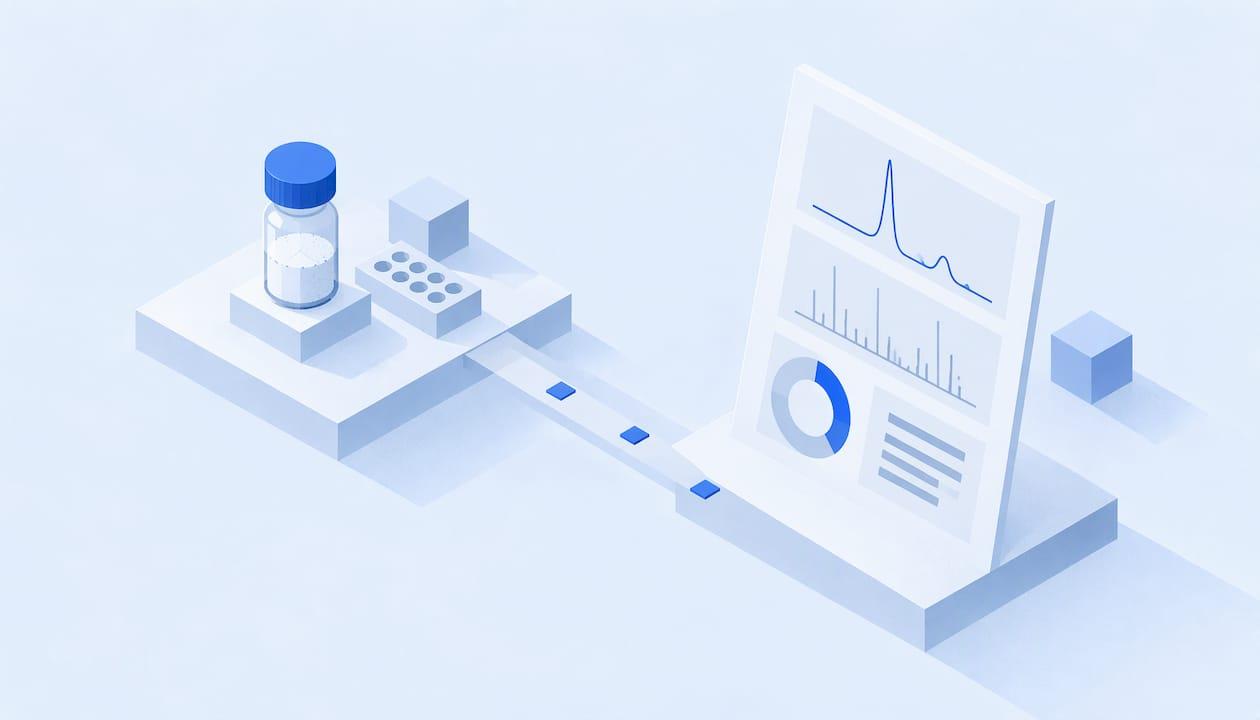
A peptide lab result is a certificate or chromatogram from an analytical lab that tells you what was in one tested batch of one product: whether it is the right molecule, how pure it is, how much of the vial is actual peptide, and whether specific contaminants were measured. A purity percentage alone answers only the first of those questions. This guide shows which numbers to look for, what each one means, and how to tell a report you can rely on from one that only looks official. At Peptide Vendor Reviews we grade vendors on independent lab tests, so reading these reports is the core of what we do.
TL;DR
- A complete report covers four things: identity (mass spectrometry), purity (HPLC), net peptide content, and contaminants such as endotoxin and microbial counts.
- A high purity percentage does not prove the right peptide is in the vial. Identity and purity are separate measurements.
- For GHK-Cu, peptide identity and purity do not establish copper content. Copper needs its own elemental test.
- Check that the report names the batch, the lab, the method, the unit and the date, and that it matches the product you are buying.
- Product lab results are not the same as blood-test results such as C-peptide, which measure your body, not a vial.
Table of Contents
- Two kinds of "peptide lab results"
- The four measurements a solid report contains
- How to read a GHK-Cu report
- Is this report really about this product?
- What lab results do and do not establish
- Why we grade on lab records
- Where to see the records
- A five-minute routine for any report
- FAQ
- Sources
Two kinds of "peptide lab results"
The phrase covers two different things, and search results mix them.
The first is a clinical result: a blood or urine test ordered by a clinician. A C-peptide test, for example, is a common one. It reflects how your body makes insulin. It tells you nothing about a vial you bought.
The second is a product result: an analytical lab tests a sample from a batch of a peptide product and reports what is in it. This is what this article covers, and it is the evidence that matters when you are deciding whether a supplier's material is what the label says.
If you are a patient, the product report is information to bring to a conversation with your physician or pharmacist, not a substitute for it. Whether any peptide is appropriate for you is a medical question that a lab certificate cannot answer.
The four measurements a solid report contains
A certificate of analysis from a competent lab states each determination with its method, result, unit and specification. One analytical lab's published description of its certificate lists the core items: identity by LC-MS with theoretical and measured mass, purity by RP-HPLC-UV as an area-normalized percentage, net peptide content as a mass fraction and in milligrams, and results for endotoxin, microbial enumeration and elemental impurities. It also recommends listing any tests that were not determined.
Here is what each one tells you.
Identity: is it the right molecule?
Mass spectrometry (MS) weighs the molecules. The lab compares the measured mass with the theoretical mass for the intended sequence. The difference between the two, often written as delta (Δ), should be tiny. If the report shows only a purity number and no measured mass, nothing in it confirms which peptide was tested.
Mass alone has limits. According to an academic review of peptide quality recommendations, MS identifies the desired product, but MS/MS data are needed to confirm the sequence and the chemical nature of impurities. Two different peptides can share a similar mass, so for modified or closely related sequences, sequence-level confirmation matters. Reference materials, such as a lysine peptide, are used in labs as known starting points when sequence and modifications are being confirmed.

Purity: how much of the peptide signal is the target?
Reversed-phase HPLC with UV detection separates a sample into peaks. Purity is usually the area of the main peak divided by the total peak area. The same academic review calls RP-HPLC with a C18 column the best method for judging how complex a peptide product is.
Three cautions help you read the number:
- A single big peak is not proof of identity. The review notes that a major HPLC peak may or may not be the desired product. MS of the peaks decides which is the peptide and which are impurities.
- Co-elution can hide impurities. The review reports co-elution with truncated peptides, meaning an impurity can travel with the main peak and make purity look higher.
- Purity is relative. A 99% area purity says that 99% of the detected UV signal at the chosen wavelength came from the main peak. It does not say that 99% of the powder is peptide.
That last point leads to the next measurement.
Net peptide content: how much of the vial is peptide?
Lyophilized peptide powder also contains water and counter-ions such as acetate or trifluoroacetate. Net peptide content gives the mass fraction that is actually peptide. The lab report should state it as a percentage and as milligrams per vial.
A worked example: a vial labeled 10 mg with a net peptide content of 80% holds about 8 mg of peptide. If purity is 99%, roughly 7.9 mg is the target peptide. Two vendors can both show "99% purity" and deliver noticeably different amounts of active material. This is why price per milligram only means something when it is calculated against content, not the label.

Contaminants: what else is in there?
The contaminant lines are the ones most often missing from vendor-supplied reports. Look for:
- Endotoxin, with a unit and a limit.
- Microbial enumeration, meaning counts of bacteria and fungi.
- Elemental impurities, such as heavy metals.
Each should show a specification beside the result. A numeric result next to a stated limit is more interpretable than a bare "pass", according to the same certificate description. A good report also says which tests were not run, so you never mistake silence for a clean result.
How to read a GHK-Cu report
GHK-Cu is a copper-binding tripeptide, and it is the peptide where readers most often over-read a certificate. The usual HPLC and MS data describe the peptide. They do not describe the copper.
A testing laboratory's GHK-Cu guidance (2026, United States) makes the point directly. Check whether the report identifies the GHK peptide and explains its measured mass and chromatographic purity basis, but do not assume those establish copper content or the intact complex. Total copper requires separate elemental analysis, such as ICP-MS, ICP-OES or atomic absorption. The same source cautions that copper-peptide complexes can be labile during sample preparation and measurement, so a mass spectrum showing a peptide ion should not be read as a direct copper measurement.
A practical GHK-Cu checklist:
| Question | What a useful report shows |
|---|---|
| Is it GHK? | Measured vs. theoretical mass with Δ |
| How pure is the peptide? | HPLC area-normalized purity, with method and wavelength |
| How much copper? | A separate elemental result (ICP-MS, ICP-OES or AAS) in mg or percent |
| How much active material? | Net content and milligrams per vial |
| What else is present? | Endotoxin, microbial and elemental impurity results |
We keep a GHK-Cu vendor page covering 148 vendors graded on lab tests, so you can compare the records rather than the marketing.
Is this report really about this product?
A report can be genuine and still be useless to you. Run these checks before relying on one. Our guide on how to verify a peptide vendor goes through the vendor side in detail. For the report itself:
- Batch or lot number. It should appear on the report and match the number on the vial or the product page. A report with no batch tells you about some batch, not yours.
- Date. Peptides are made in batches, and a report from a past batch says little about the current one. Look for a test date close to the manufacturing or listing date.
- Who tested it. A lab name, address and contact detail you can look up. An independent lab is one with no ownership link to the seller. A report on the seller's own letterhead is the weakest kind of evidence.
- Sample origin. Was the sample taken from finished, vialed product or from a bulk lot before filling? Finished product is closer to what you receive.
- Method and unit on every line. A number without a method or unit cannot be checked.
- Peptide name and sequence match. The product name, the sequence and the reported mass should agree with one another.
- An original you can trace. A scanned certificate you can follow back to a lab is stronger than a cropped screenshot of a table.
For vendors reading this to verify their own integrity: the same list is your quality standard. Reports that carry batch numbers, dates, methods, specifications and the list of undetermined tests are the ones buyers can trust, and the ones that hold up when someone compares them to independent results.
What lab results do and do not establish
A product lab result is evidence about a specific sample. Read it for exactly what it says.
What it can establish: the tested sample matched the intended mass, had the stated chromatographic purity, contained a measured amount of peptide, and met or missed the stated limits for the contaminants the lab actually tested.
What it does not establish on its own:
- Anything about other batches, or about vials from the same batch that were not sampled.
- Sterility or endotoxin levels, unless those tests appear on the report with results and limits.
- Suitability for human use. Analytical purity is a quality measure for research material. It is not a safety or dosing recommendation.
If you are a patient or are considering a peptide for your own health, talk with your doctor or pharmacist before use, especially if you take medications or have a medical condition. A lab report tells you about the product. Your clinician tells you whether it fits your situation.
Why we grade on lab records
We started Peptide Vendor Reviews because a purity number on a product page is easy to print and hard to check. Our database now compiles 12,423 independent lab tests across 481 peptide vendors, and every vendor grade comes from those tests alone, never from paid submissions or vendor marketing.
We link each score to the original lab certificate, so you can open the document and read the mass, the purity, the content and the contaminant lines yourself, using the method in this article. Our reviews and rankings cannot be influenced by advertising or affiliate partnerships, and our grading rubric is public.
The people who gain most are researchers who need the right molecule, health enthusiasts who want quality assurance, and vendors who want an honest benchmark of their own product integrity. A graded record is a better starting point than a promise.
Ross
Where to see the records
If you want the numbers rather than the theory, start with our peptide purity page, which shows lab results for each peptide, or the full vendor list, where every shop is graded by lab tests. Each vendor review links back to the original certificates behind its score. We earn a commission when readers buy through our vendor links, and that does not change a grade.

If a vendor has no independent tests yet, its page says so. You can also read how samples are handled on our sample testing information page.
A five-minute routine for any report
When you open a certificate, work down this order:
- Find the batch number and date.
- Find the lab and confirm it is independent of the seller.
- Compare measured mass to theoretical mass.
- Read the purity method and the percentage.
- Find net peptide content in mg and calculate the real amount in your vial.
- Read the contaminant lines and note which tests are absent.
- For GHK-Cu, look for a separate copper measurement.
If steps 3 and 5 are missing, you have a purity claim, not a full lab result.
FAQ
What is a good purity percentage for a peptide?
Purity is only meaningful with its method and with identity confirmed by mass. Research-grade material is commonly reported in the high 90s by HPLC area. Read it together with net peptide content, because purity describes the peptide signal and not how much of the powder is peptide.
Are peptide lab results the same as C-peptide or blood test results?
No. A C-peptide test is a clinical blood or urine test that reflects how your body makes insulin. A product lab result describes what is in a vial from one batch. They answer different questions and are ordered by different people for different reasons.
Does a GHK-Cu report show how much copper is in the vial?
Only if it includes a separate elemental analysis such as ICP-MS, ICP-OES or atomic absorption. Laboratory guidance on GHK-Cu states that peptide identity and purity data do not establish total copper or the intact complex amount.
How do I know a report belongs to the product I am buying?
Match the batch number, the peptide name and sequence, and the test date to the product and listing. Confirm that a named, independent laboratory issued the report and that you can trace it to an original document. Our vendor verification checklist walks through the checks.
Does a clean lab report mean a peptide is safe to use?
No. A report describes the quality of a tested sample, including only the contaminants the lab measured. Whether a peptide suits you is a medical decision, so speak with your doctor or pharmacist before using one, particularly if you take other medications.
Sources
- What an ANALYTON certificate of analysis contains
- Recommendations for the generation, quantification, storage and handling of peptides (PMC)
- GHK-Cu Testing: Peptide Identity, Quantity and Purity