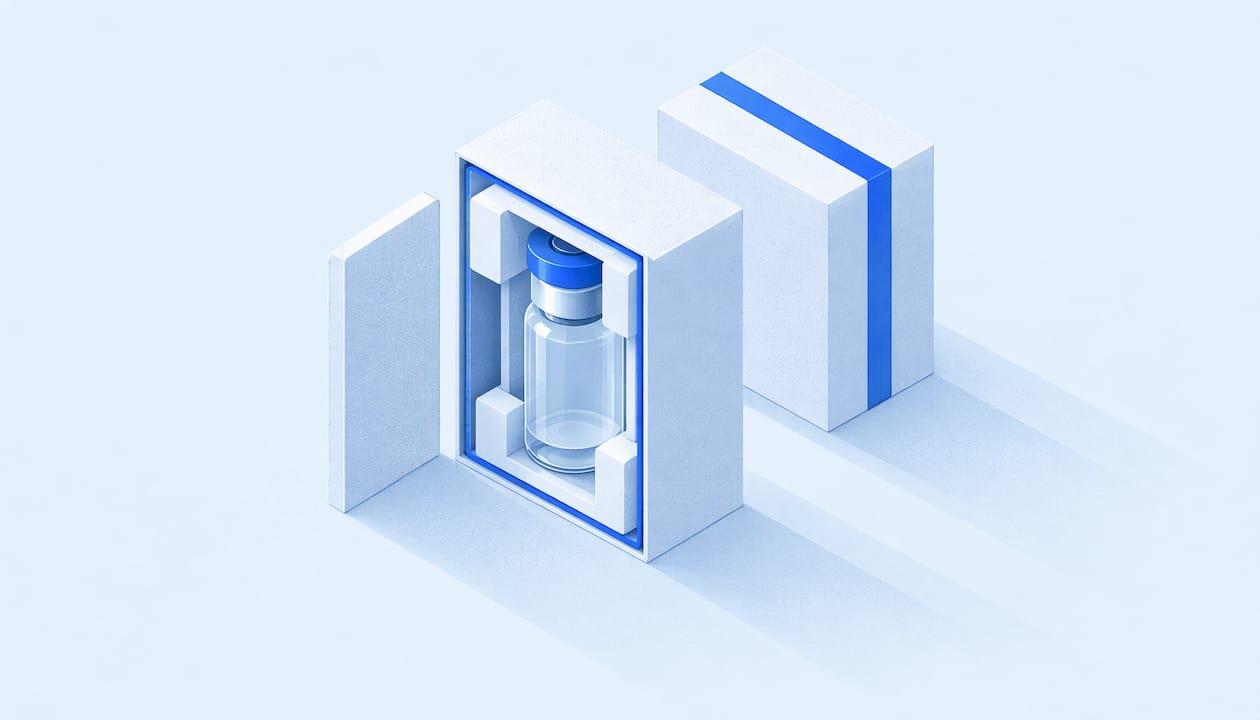
Good peptide packaging keeps out the four things that break peptides down: moisture, oxygen, light and heat. A pretty box tells you nothing about any of them. What matters is the sealed vial, the stopper, how the powder was dried, and whether the shipment stayed cold and intact in transit. A purity score on a certificate only describes the powder at the moment it was tested, so packaging is what decides whether that number is still true when the vial reaches you. At Peptide Vendor Reviews we grade vendors on independent lab tests and link each score to the original certificates, which is the right starting point for judging a supplier's product before you look at how it arrives.
TL;DR
- Packaging exists to protect stability: moisture, oxygen, light and temperature swings are what degrade peptides, not appearance.
- Lyophilized (freeze-dried) powder in a sealed, light-protected glass vial is far more stable than a peptide in solution.
- Regulators expect cold-chain shipments to be qualified with temperature recording, which is a useful standard for judging any vendor.
- Signs of trouble include a loose or cracked seal, a collapsed or discolored cake, moisture inside the vial, and a shipment that arrived warm.
- Lab results for a specific batch tell you more than box design. Check them against the vendor's certificates.
Table of Contents
- Why packaging matters more than the box
- What actually damages a peptide
- The vial: glass, stopper and seal
- Shipping: where good vials go bad
- How to tell whether a vial has been compromised
- Packaging claims versus lab evidence
- Find vendors whose results hold up
- FAQ
- Sources
Why packaging matters more than the box
When search results for this topic talk about packaging, many mean branded boxes, labels and luxury cases. For someone buying peptides, the relevant packaging is the container closure system: the vial, the stopper and the seal that hold the powder, plus the secondary packaging such as the insulated shipper around it.

The FDA's container closure guidance treats light transmission, moisture permeation and container closure integrity as the core tests of whether a system protects its contents. The EMA's synthetic peptide guideline says the closure system should suit the substance, its storage conditions and its use, and that hygroscopic powders (ones that pull water from the air) may call for a desiccant or inert-atmosphere storage.
In plain terms: a peptide can be made to a high standard and still be damaged afterward if moisture, oxygen, light or contaminants get into the vial.
What actually damages a peptide
Each threat maps to a specific kind of damage, which is why each packaging feature exists.
| Threat | What it does | Packaging answer |
|---|---|---|
| Moisture | Speeds hydrolysis (backbone breakage) and deamidation of asparagine and glutamine | Dry lyophilized powder, tight seal, desiccant in secondary container |
| Oxygen | Oxidizes methionine, tryptophan and cysteine residues | Sealed vial, low headspace oxygen, inert gas fill |
| Light | Drives photochemical change in aromatic residues | Amber or opaque vials and outer cartons |
| Heat | Accelerates every reaction above | Refrigerated or frozen storage, insulated shipper with refrigerant |
| Contamination | Oxidants, trace metals or microbes can cause oxidation, cleavage and disulfide exchange | Intact closure, clean fill process |
These pathways are described in the EMA guideline and in a 2023 review of peptide formulation stability, which notes that sulfur-containing residues are especially prone to oxidation and that removing oxygen and blocking light are standard ways to limit it.
Temperature is the easiest to appreciate. A 2025 mass spectrometry study found deamidation was pronounced at 60°C, slower at 20°C and negligible at 4°C and -20°C, even with freeze-thaw cycles. Cold storage works. Warm transit is where the risk sits.
The vial: glass, stopper and seal
Glass and light protection
Pharmaceutical-grade peptide reference lots are commonly filled in Type I amber glass vials. A 2023 paper on peptide reference standards describes lyophilized lots in Type I amber glass sealed with halobutyl closures. Amber glass filters light, and Type I glass is the chemically resistant grade. A clear vial is not automatically a failure, but a vendor that ships in amber or keeps vials in an opaque carton shows it understands light sensitivity.

The stopper and crimp seal
The rubber stopper is the weak point of most vials. Research by Qi and colleagues in 2021 tested twelve drug products across glass vial sizes and several stopper formulations and found that extractables testing predicted what leached, with no leachate issues up to 65 months at 5±3°C for a lyophilized product. The takeaway for a buyer is that a well-chosen stopper in a dry, cold-stored vial is a stable system.
The seal itself needs to hold. FDA guidance lists helium leak, pressure or vacuum decay and dye ingress among the methods for testing closure integrity, and notes that rubber stoppers can lose elasticity at very low temperatures. A crimp that looks tight and a stopper that sits flush are the visible signs of a seal built to last.
Moisture and oxygen inside the vial
The reference-standards paper measured residual moisture of 1.11 to 2.79% w/w and headspace oxygen of 0.57 to 1.58% across six lyophilized peptides, and treats both as key quality attributes. A 2024 formulation study found that replacing vial headspace air with nitrogen to hold oxygen at 0.1% or below, and extending secondary drying to cut water content, were effective ways to limit oxidation and hydrolysis. You cannot measure these at home, but you can ask whether a vendor's testing covers them.
Shipping: where good vials go bad
The EMA guideline says peptides are generally stored refrigerated (5°C ± 3°C) or frozen (-20°C ± 5°C), with higher-temperature data used to cover short-term excursions. The FDA's guidance goes further for cold-chain products: shipping containers should be qualified with temperature recording systems under worst-case temperature and transit time, and freeze-thaw and thermal cycling studies should confirm that quality and closure integrity hold.
Vendors are not held to a pharmaceutical standard, but the standard shows what good looks like:
- Lyophilized form. Powder travels far better than solution.
- Insulation and refrigerant sized for the longest realistic transit, with a buffer for delays.
- Cushioning per vial, so glass does not knock together.
- Light protection such as amber glass or an opaque outer layer.
- A desiccant in the secondary container.
- A temperature logger for high-value lots, where a vendor offers one.
For how vendors compare on transit times, packing and warning signs, see our guide to peptide vendor shipping.
One point of regulation is worth knowing. USP chapter <659> says articles without specific labeling directions must be protected from moisture, freezing, excessive heat and, where necessary, light during shipping and distribution, per the USP revision notice. It is a pharmacopeial standard for drug products, but it sets a sensible baseline for what a package should survive.
How to tell whether a vial has been compromised
No single sign proves damage, and appearance alone is weak evidence. The EMA frames valid stability claims around defined packaging, conditions, time points and analytical methods, noting that HPLC or LC-MS may be needed depending on the failure. Still, these observations are worth recording the moment a package arrives:
- Seal and stopper: a loose crimp, cracked glass, a stopper pushed out of position or visible punctures.
- The powder: a cake that looks wet, collapsed, shrunken or discolored when others in the same batch look fluffy and uniform.
- Moisture: droplets or fogging inside a vial that should be dry.
- Transit conditions: a shipper that arrived warm, with refrigerant fully melted, or with a logger reading outside range.
- Labeling: smudged, missing or mismatched batch information, which also blocks you from checking the lot against its certificate.
If something looks off, photograph it, keep the packaging, and contact the vendor. For a quantitative answer, a lab test of the sample is the only real check, and our sample testing page explains how to get a peptide sample lab-tested. Our explainer on peptide stability testing shows how to read the results.
Packaging claims versus lab evidence
A vendor can describe nitrogen-flushed amber vials and cold packs on a product page. The claim only becomes useful when results for the specific batch back it up. Three kinds of evidence are worth looking for:
- Purity and identity on a batch certificate, which you can read with our guide to peptide batch testing.
- Label accuracy, meaning the vial contains the amount stated, covered in peptide label accuracy.
- Sterility, especially for products meant for injection, explained in peptide sterility testing.
Degraded powder tends to show up as lower purity or extra peaks on a chromatogram, so independent testing is where packaging failures become visible. If you want a broader checklist for the vendor itself, see how to verify a peptide vendor.
Our view
We grade vendors on independent lab tests, never on paid submissions or marketing, and we link every score to the original certificate. That approach is why we think packaging should be judged by outcomes: a vendor whose vials test at their stated purity and amount, batch after batch, has packaging and shipping that work. A glossy box cannot give you that, and neither can a product page.
Our database draws on thousands of independent lab tests across hundreds of vendors, and our rankings cannot be influenced by advertising or affiliate partnerships. When you read a grade, you are reading what was in the vial, not what was on the label.
Ross
Find vendors whose results hold up
Our ranked list of peptide vendors lets you compare suppliers by their independent lab results, with the certificates behind each grade. If you want to see how scores are built first, read how we grade peptide vendors.

FAQ
How should peptides be delivered?
Lyophilized powder in a sealed, light-protected vial, inside an insulated shipper with enough refrigerant for the full transit plus delays. Regulators expect cold-chain shipments to be qualified with temperature recording, as the FDA's container closure guidance states.
How can you tell if a peptide has gone bad?
Look for a broken seal, a wet, collapsed or discolored cake, and signs the shipment arrived warm. Appearance is only a hint, though. A lab test measuring purity is the reliable way to confirm.
Does the vial material matter?
Yes. Amber Type I glass with a well-fitted halobutyl stopper is the pharmaceutical norm for lyophilized peptide lots, as seen in a 2023 reference-standards paper. It blocks light and limits moisture and oxygen entry.
How should I store peptides after they arrive?
Peptide guidance generally calls for refrigerated storage at 5°C ± 3°C or frozen at -20°C ± 5°C, dry and protected from light, per the EMA guideline. Follow the storage directions on your specific product, and ask your doctor or pharmacist about any peptide prescribed for you.
Sources
- FDA, Container Closure Systems for Human Drugs and Biological Products (2026)
- EMA, Guideline on the Development and Manufacture of Synthetic Peptides
- USP <659> Packaging and Storage Requirements
- Nugrahadi et al., Designing Formulation Strategies for Enhanced Stability of Peptide Products (2023)
- Erckes et al., Revealing deamidation and isoaspartate formation (2025)
- Qi et al., Extractables and Leachables, Journal of Pharmaceutical Sciences (2021)
- McCarthy et al., Reference Standards to Support Quality of Synthetic Peptide Therapeutics (2023)
- Xiong et al., Stable Peptide-Loaded Long-Acting Injection (2024)