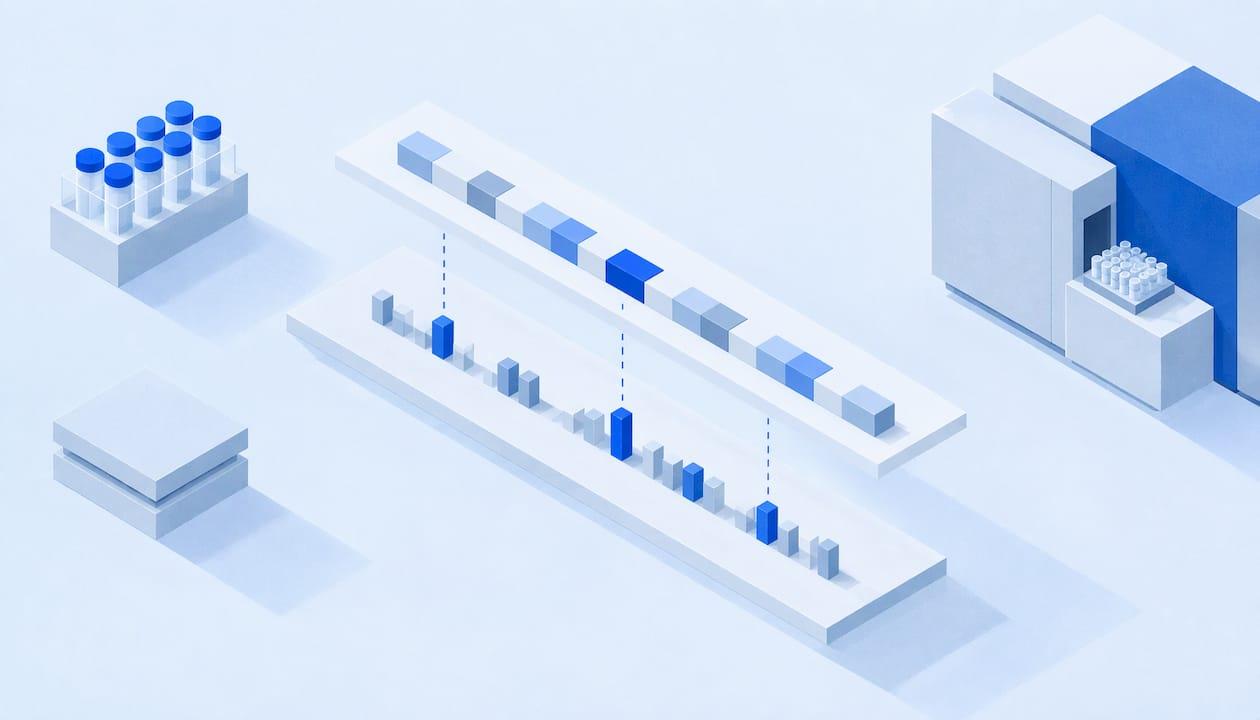
Peptide sequence verification is the process of checking that analytical data supports the order of amino acids a peptide is supposed to have. It is usually done with tandem mass spectrometry (MS/MS), often backed by amino-acid analysis and HPLC. A purity percentage alone does not do this job. A clean, well-purified peptide with the wrong sequence can still show high purity on a chromatogram.
This guide explains what each method establishes, how to read fragment-ion evidence, where confidence runs out, and what to look for on a certificate of analysis.
TL;DR
- Verification asks whether the data supports a proposed sequence. Determination (de novo sequencing) works out a sequence from scratch.
- MS/MS is the main tool. It fragments the peptide and reads the residue order from mass differences between b and y ions.
- No single test settles identity. Labs combine mass spectrometry, amino-acid analysis and HPLC.
- Software can be wrong, so expert review of the spectra matters.
- Identity data says nothing about whether a peptide is safe or suitable for human use.
Table of Contents
- Verification versus determination
- Why a high purity number does not prove identity
- The methods, and what each one can verify
- How MS/MS reads a sequence
- Where confidence runs out
- Reading a certificate of analysis
- What identity testing does not tell you
- Perspective
- Find vendors with lab records behind them
- FAQ
- Sources
Verification versus determination
The two terms get mixed up, and the difference decides which test you need.
Determination starts with an unknown. The analyst has spectra and builds a sequence from them. This is de novo sequencing, and it is the only route for organisms with unknown genomes, novel splice variants and antibodies.
Verification starts with a claim: this vial is supposed to hold a specific sequence. The question is whether the data is consistent with that sequence and inconsistent with plausible alternatives. For a synthetic peptide with a known target, this is the question that matters.
The sequence is not a minor detail. NIST's work on primary structure treats it as a critical quality attribute that shapes function and stability. NIST says the amount of orthogonal characterization needed should be decided based on what the first analysis can and cannot show.
Why a high purity number does not prove identity
HPLC separates the components in a sample and reports the share of the signal belonging to the main peak. It tells you the sample is mostly one thing. It does not tell you which thing.
A manufacturer's GMP specification document makes the point directly: no simple single test establishes identity in terms of composition, sequence and chirality, with the exception of NMR, which it describes as expensive and slow. Labs use a combination, typically mass spectrometry, amino-acid analysis and HPLC. Industry guidance reviewed in Biopharm International notes that two separate identification methods are required under ICH because one method is rarely unequivocal.

So a certificate showing "98% purity" answers one question. If a sequence is mis-synthesized but cleanly purified, the chromatogram can look excellent. That is why we show purity and identity evidence side by side. You can see how purity results look across vendors on our peptide purity page.
The methods, and what each one can verify
| Method | What it establishes | What it cannot do alone |
|---|---|---|
| Intact-mass MS | Monoisotopic mass matches the expected composition | Cannot show residue order or distinguish isomers |
| MS/MS fragmentation | Residue order, via b and y ion series | Can be ambiguous for isobaric residue pairs |
| Peptide mapping (LC-MS/MS) | Sequence coverage, modifications | Depends on enzyme digestion and software settings |
| Amino-acid analysis | Which amino acids are present and in what ratio | Does not give order; hydrolysis can destroy some residues |
| HPLC | Relative purity, separation of impurities | Does not confirm sequence |
| Edman degradation | Stepwise chemical confirmation of the N-terminal region | Slow, and blocked N-termini defeat it |
| 1D 1H NMR | Can establish identity and purity together | Costly, needs complex interpretation |
The first row matters most for buyers. Intact mass is the most common identity line on a vendor certificate. It is useful: it catches large errors such as a missing residue or a wrong peptide entirely. But two different sequences built from the same residues have the same mass, so a matching mass is consistent with the target and with its scrambled cousins.
Amino-acid analysis hydrolyzes the peptide and quantifies the released amino acids, as the manufacturing quality-control document describes. It confirms composition. It does not confirm order.
Edman degradation reads from the N-terminus, one residue at a time. A 2026 industry write-up describes it as direct and unambiguous for accessible N-terminal regions, with limits on throughput and blocked N-termini. It is typically a tiebreaker when MS fragment ions leave doubt.
NMR is the outlier. A 2019 paper on quality control of therapeutic peptides by 1H NMR shows it can establish purity and identity, and notes that its capabilities are rarely used. Few vendor certificates include it.
How MS/MS reads a sequence
In tandem mass spectrometry the instrument first records a survey scan of the intact peptide ions. It then isolates a selected precursor, fragments it and measures the product ions. The precursor scan gives the peptide's mass and charge state. The fragment scan gives the structural detail.
Common collision-induced dissociation (CID) breaks the peptide backbone at the amide bonds. Educational material from the ASDLib proteomics series explains that this produces b and y ions, and the mass differences between consecutive ions match the residues lost. A review of de novo sequencing adds that a, b and c fragments keep the charge on the N-terminal side, while x, y and z fragments keep it on the C-terminal side, each numbered from its own end.
A worked way to think about it:
- The precursor mass tells you the total residue mass.
- The y-ion ladder reads the sequence from the C-terminus. Each step up the ladder is one residue.
- The b-ion ladder reads from the N-terminus. It should tell the same story from the other side.
- If both ladders agree with the proposed sequence across most of its length, the evidence is strong. Gaps, where no fragment appears, leave stretches unconfirmed.
For a visual walk-through of how these fragment series support residue order, this explainer on mass spectrometry peptide verification is a good companion read.
Where confidence runs out
Good spectra can still mislead. Three problems come up repeatedly.
Isobaric residues. A 2025 study of peptide mapping for sequence confirmation counts 190 possible dipeptides from the 20 natural amino acids. Of these, 13 pairs share exactly the same elemental composition, and 61 dipeptides share their mass with at least one other within a 100 ppm window. That is nearly a third of all combinations. Swapping such a pair can leave the precursor mass unchanged and, without clear fragments between them, the spectrum ambiguous.
Software artifacts. The same study showed commercial software producing incorrect assignments, including artificial modifications added to compensate for a mismatch and misread isotope peaks. Its conclusion is that expert manual review of MS2 spectra is important.
Search-engine limits. The Hunt Lab guide notes that only about one in four MS/MS spectra can be mapped to a protein sequence, and that an unexpected sequence or modification cannot be identified correctly by database search. An older review of de novo algorithms reports top-ranked candidates are about 80 to 90% accurate for low-resolution CID spectra and 90 to 92% for high-resolution, against database results that can be validated at a 1% false discovery rate.
Another angle on the same theme: reviewing fragmentation evidence, search parameters and confidence scores is part of reading LC-MS data responsibly, rather than accepting a single "match" label.
Higher-end techniques help. ETD and EThcD fragmentation can strengthen confirmation, though the 2025 paper notes that acquisition time and validation complexity can limit their use in regulated quality control. High-resolution Orbitrap or Q-TOF instruments reach mass accuracy below 2 to 5 ppm, which narrows the list of candidates.

Reading a certificate of analysis
When you hold a lab report for a peptide, run through these questions.
- Who ran it? An independent lab is a different thing from the seller's own in-house instrument.
- Is it tied to a lot? A report for one batch says nothing about the next.
- What does the identity line rest on? "Mass confirmed" is intact mass. "Sequence confirmed" should point to MS/MS or another method that reads order.
- Is the spectrum or chromatogram included? A bare number is less informative than the trace behind it.
- Does the expected mass match the sequence you think you bought? Check that the observed and theoretical values agree within the stated tolerance.
- Are there other results on the same vendor? One favorable report is a data point, not a record.
This last point is why we gather results across many tests rather than relying on single certificates. Our guide on how to verify a peptide vendor lays out seven checks to run before you order, and our sample testing information page explains how samples get tested independently.
What identity testing does not tell you
A confirmed sequence is an analytical finding about one sample. It is not a statement about whether a compound is safe, sterile, correctly dosed or appropriate for any person. Intact mass and sequence work do not measure sterility, endotoxin or absolute content. A lab report is also not a regulatory approval of any kind.
If you are a patient considering any peptide for your health, the person to talk to is a licensed physician or pharmacist, who can tell you what is approved and appropriate for your situation.
Perspective
Our view after reading thousands of lab results is simple: purity and identity are separate questions, and buyers deserve both answered with data.
We grade vendors solely on independent lab tests, never on paid submissions or vendor marketing, and every score links to the original lab certificates. That lets you read the evidence yourself instead of trusting a badge. We think the most useful thing a review site can do is put the certificate in front of you and show how one vendor's results compare with the rest.
Our platform compiles 12,423 independent lab tests across 481 vendors. Our reviews and rankings are not influenced by advertising or affiliate partnerships, and we built the site to keep it that way. When you see a vendor with strong, repeated results, that record is what earned the grade.
Ross
Find vendors with lab records behind them
If you are choosing a supplier, start from the evidence. Our peptide vendor list shows every shop graded on independent lab tests, with scores linked to the original certificates. You can also compare cost per milligram on the peptide price list.

Browse the full set of records on the Peptide Vendor Reviews homepage. Some vendor links on the site are affiliate links, and the grades are not affected by them.
FAQ
What is the difference between peptide sequence analysis and verification?
Analysis, or determination, works out an unknown sequence from spectra, often by de novo sequencing. Verification tests a specific proposed sequence against the data. For a synthetic peptide with a known target, verification is the usual goal.
Can HPLC confirm a peptide's sequence?
No. HPLC separates components and estimates relative purity, but it does not read residue order. Manufacturers pair it with mass spectrometry or amino-acid analysis, as the ICH-based guidance on two identification methods describes.
Is a matching molecular weight enough to confirm identity?
It is a good first check, and it catches large errors. But sequences with the same residues in a different order share a mass, so intact mass cannot show order. MS/MS fragment ions are what reveal the order.
What is the most reliable way to confirm a peptide sequence?
There is no single test. Labs combine high-resolution LC-MS/MS with amino-acid analysis and HPLC, and sometimes Edman degradation or NMR. Manual review of the spectra by an experienced analyst adds a layer that software alone does not.
Sources
- Determination of the Primary Sequence/Structure, NIST
- The Hunt Lab Guide to De Novo Peptide Sequence Analysis, Molecular & Cellular Proteomics
- Quality control in peptide manufacturing: specifications
- Control Strategies for Synthetic Therapeutic Peptide APIs, Biopharm International
- Sequence Confirmation Services for Synthetic Therapeutic Peptides
- Quality Control of Therapeutic Peptides by 1H NMR HiFSA Sequencing
- A Face in the Crowd: Recognizing Peptides Through Database Search
- Sequencing peptides from tandem MS data, ASDLib
- Lessons in De Novo Peptide Sequencing by Tandem Mass Spectrometry
- Peptide Mapping for Sequence Confirmation of Therapeutic Peptides
- Sequencing-Grade De novo Analysis of MS/MS Triplets
- Mass Spectrometry Peptide Verification Explained
- LC-MS for Peptides: How It Works and What to Check