Verify Every Lot With HPLC/MS: Clinical Peptide Sourcing for Clinics
Written by Jian Wang, Founder & CEO · · Updated
Clinically administered peptides must come from a licensed 503A or 503B compounding pharmacy that issues a lot-specific certificate of analysis backed by HPLC and mass spectrometry data. If a supplier labels product “research use only,” can’t produce a batch-matched COA, or dodges questions about compounding status, that order gets paused. Verify pharmacy licensure through the relevant state Board of Pharmacy and require the lot COA before the first vial ever reaches a patient.
TL;DR:
- Peptides must be sourced from licensed 503A or 503B pharmacies that provide lot-specific COAs verified by HPLC and MS data, not from suppliers claiming “research use only.”
- Verify pharmacy licensure directly through the state Board of Pharmacy, and ensure batch numbers on packaging match those on the COA before clinical use.
- Always treat the first shipment as a qualification lot, testing and quarantining it until documentation and cold-chain integrity are confirmed.
- Maintain a diversified supplier network with at least two qualified sources and stock safety stock for critical peptides to reduce supply chain risks.
- Follow a structured procurement process and build an internal documentation system to streamline recalls, traceability, and compliance audits.
Table of Contents
- Clinic-Ready Compliance Checklist Before You Order
- How to Vet Peptide Suppliers Step by Step
- 503A vs 503B: Which Compounding Pathway Applies to Your Clinic
- What a Lot-Specific COA and HPLC/MS Data Should Show
- Cold Chain: What Happens Between the Lab and Your Clinic
- Building Supply Resilience Without Overcommitting Budget
- A Clinic Procurement Workflow That Reduces Compliance Risk
- Bottom Line for This Week’s Orders
- Regulatory Compliance Beyond Supplier Verification
- Risk Management: Counterfeits, Recalls, and What to Do When Something Goes Wrong
- What Clinical Peptide Sourcing Actually Costs
- Ethical Sourcing Practices in Peptide Acquisition
- Author Perspective: Why Procurement Culture Has to Change
- How Peptide Vendor Reviews Fits Into Your Sourcing Workflow
- Sources
- FAQ
Clinic-Ready Compliance Checklist Before You Order
Every new peptide relationship should pass a short gate before purchasing authority is granted. Skipping this step is how clinics end up defending a purchase decision to a state board months later.
Start with the supplier’s regulatory identity. Confirm they operate as a 503A or 503B compounding pharmacy, not a chemical distributor wearing a pharmacy’s branding. Professional guidance on peptide sourcing is blunt about this: peptides not obtained through a legitimate compounding pharmacy are not legal to administer clinically, full stop, and that exposure lands on the prescribing clinic, not just the vendor.
From there, work through this list on every new supplier and on any existing supplier introducing a new peptide or lot:
- Confirm the supplier’s compounding designation (503A or 503B) and cross-check it against the state Board of Pharmacy database directly, not against a claim on the vendor’s website.
- Require a lot-specific COA showing HPLC and MS results, with the batch number on the COA matching the batch number printed on the physical packaging.
- Validate supplier identity beyond a landing page: a physical facility address, a working phone line, business registration, and a named quality control contact you can actually reach.
- Get written confirmation of packaging standards, beyond-use date or expiration date, and cold-chain handling commitments before the first order ships.
- Document the chain linking prescription, patient, and lot number in the clinical record so any downstream recall or adverse event can be traced in minutes, not days.
None of this is exotic. It’s the same discipline pharmacies already apply to injectable drug stock. Peptides just haven’t caught up to that habit in every clinic, yet.
How to Vet Peptide Suppliers Step by Step
Clinical peptide sourcing rewards a sequence, not a gut check. Run new suppliers through the same five-step process every time, and resist the urge to shortcut it for a supplier who “seems legitimate” or offers a lower price on a hard-to-source peptide.
- Run the licensing check first. Search the supplier’s name and pharmacist-in-charge against the state Board of Pharmacy license lookup. A confirmed 503A or 503B designation with an active license is the baseline. A vendor that resists naming their compounding pharmacist or facility address has already failed this step.
- Request lot-specific COAs and ask technical follow-up questions. Ask what HPLC column and detection method they use, what their purity acceptance threshold is, and whether MS confirms identity separately from HPLC’s purity read. A quality team that can’t answer in plain terms is a red flag regardless of how polished their paperwork looks.
- Watch for blended-sourcing signals. RUO language buried in fine print, COAs with no batch number, or a supplier that can’t explain where their active pharmaceutical ingredient originates all suggest the product may be repackaged research-grade material, not pharmacy-compounded stock.
- Order a test lot before committing to routine procurement. Treat the first shipment as a qualification batch: verify the COA against the physical lot, confirm cold-chain integrity on arrival, and hold the material in quarantine until your own documentation checks clear.
- Loop in your pharmacist or compliance officer for anything ambiguous. If a supplier’s answers raise more questions than they resolve, that’s the moment to escalate internally, not the moment to place a larger order to lock in pricing.
Pro Tip: Ask a prospective supplier to walk you through their most recent COA line by line on a call. A vendor that genuinely runs in-house or third-party HPLC/MS testing will talk about retention times and peak resolution without hesitation. One that’s reselling relabeled stock usually can’t.
503A vs 503B: Which Compounding Pathway Applies to Your Clinic
The compounding pathway you use determines whether your peptide order is even legal to administer, and the two models work differently enough that clinics need to know which one fits their situation before they place an order.
503A pharmacies compound patient-specific preparations against an individual prescription. This is the pathway for a clinic writing a prescription for a named patient, where the pharmacy compounds that specific dose for that specific person. It’s the traditional compounding model, and it requires a valid prescription tied to a diagnosed clinical need.
503B outsourcing facilities compound in bulk under stricter FDA oversight, without requiring a patient-specific prescription for each unit produced. Clinics that need office-use stock, rather than one-off patient prescriptions, typically source from 503B facilities because that’s the model built for bulk clinical supply.
Neither pathway is satisfied by a product labeled “for research use only” or “physician use only.” Those labels are not a substitute for pharmacy compounding oversight. They’re a legal category for material that hasn’t gone through the compounding, testing, and labeling requirements clinical administration demands.
The recordkeeping differs too:
- 503A orders should generate a documented prescription, patient identifier, and lot number tied together in the clinical chart.
- 503B orders should generate purchase records tied to facility registration numbers and lot-specific COAs, since there’s no individual prescription anchoring each unit.
- Both pathways require the pharmacy’s compounding license to stay current, which means an annual or periodic recheck against the state Board of Pharmacy, not a one-time verification at onboarding.
What a Lot-Specific COA and HPLC/MS Data Should Show
A certificate of analysis is only useful if it’s tied to the exact batch in your hands, not a generic “typical results” sheet the vendor reuses across shipments. Generic COAs are common in the gray market and they tell you nothing about the vial sitting in your clinic’s refrigerator.
HPLC (high-performance liquid chromatography) separates the compound from impurities and reports a purity percentage based on peak area. Mass spectrometry confirms molecular identity, verifying that what’s in the vial actually matches the peptide on the label rather than a structurally similar but incorrect compound. Together, they answer two separate questions: is this pure, and is this the right molecule.
When a COA lands on your desk, check for:
- The batch or lot number on the COA matching the number printed on the vial or box exactly, character for character.
- A stated purity percentage from HPLC, along with the acceptance threshold the lab used to pass or fail that batch.
- MS data confirming molecular weight or sequence identity, not just a purity number standing alone.
- The testing lab’s name and accreditation, ideally independent of the manufacturer producing the peptide.
Best practice calls for COAs that combine both HPLC and MS on the same lot. A HPLC-only report can show a clean purity percentage while still missing a contaminant with a similar retention time, which is exactly what MS is built to catch. If a supplier only offers one or the other, that’s grounds to request independent third-party testing before the lot gets used clinically, and it’s the same logic behind why Peptide Vendor Reviews’s vendor comparison platform surfaces both data types side by side rather than treating a single test as sufficient proof of purity.
Cold Chain: What Happens Between the Lab and Your Clinic
Peptides degrade under heat and light exposure, and a shipment that sat on a loading dock for six hours in July can quietly lose potency without any visible sign on the vial. Cold-chain failures are one of the most common ways a clinically sound peptide turns into a clinically useless one before it’s ever administered.
Reputable suppliers ship with validated packaging, meaning insulated containers and gel packs or dry ice qualified to hold a specific temperature band for a specific duration, not generic foam and an ice pack. Cold-chain guidance for healthcare shipments recommends real-time temperature monitoring with a data logger inside the package, so any excursion during transit gets flagged with a timestamp rather than discovered after the fact.
On receipt, your team should run a short but non-negotiable checklist:
- Inspect the shipping container’s seals for damage or signs of tampering before opening.
- Photograph the packaging, temperature indicator, and any included data logger printout.
- Log the arrival temperature against the supplier’s stated acceptable range immediately.
- Quarantine the shipment until documentation is verified, rather than moving it straight to active clinical stock.
Keep the distinction between beyond-use date and expiration date straight in your records. A compounded preparation’s BUD is set by the compounding pharmacy based on stability data and storage conditions, and it’s typically shorter than a manufacturer’s expiration date on a bulk ingredient. Using a vendor’s expiration date instead of the pharmacy’s BUD is a common documentation error that can put expired-in-practice product into a patient.
Pro Tip: If a supplier can’t produce a temperature log for a specific shipment on request, treat that as equivalent to a missing COA. No log means no proof the cold chain held, regardless of how the vial looks on arrival.
Building Supply Resilience Without Overcommitting Budget
Single-sourcing a critical peptide is a bet that one supplier’s facility, regulatory standing, and shipping lane never has a bad month. Resilient supply chain strategies for peptide therapeutics point to qualifying multiple suppliers and diversifying geographically as the standard defense against exactly that scenario.
For any peptide central to an active clinical program, qualify at least two independent suppliers and document their minimum order quantities and qualification timelines side by side. That documentation matters later: if your primary supplier has a recall or licensing lapse, you want your backup already vetted rather than starting the compliance process from zero during a shortage.
Peptide supply chains face compounding risk from geographic concentration and regulatory complexity, and maintaining eight to twelve weeks of safety stock for critical reagents is a common buffer against lead-time spikes tied to those pressures. That number will vary with your clinic’s volume, but the principle holds regardless of scale: don’t let your reorder point sit right at your lead time with zero cushion.
A few practical habits keep backup suppliers audit-ready rather than theoretical:
- Run small qualification batches through backup suppliers periodically, even when you’re not actively buying from them.
- Track each qualified supplier’s MOQ and typical lead time in a shared procurement log your team actually checks.
- Weigh the cost premium of domestic or allied-country suppliers against the reliability gain, since faster resolution on a compliance question or recall can outweigh a modest per-unit price difference.
- Reaudit qualified backups on a fixed schedule, not only when the primary supplier fails.
A Clinic Procurement Workflow That Reduces Compliance Risk
Structured procurement beats ad-hoc buying because it forces a documented decision gate at every stage instead of trusting a single email exchange. A clean version looks like this:
- Initial inquiry. Confirm compounding designation and licensing before requesting pricing.
- Documentation request. Get the lot-specific COA, HPLC/MS results, and cold-chain commitments in writing.
- Sample or first-lot testing. Verify the physical shipment matches the paperwork, ideally with independent confirmation.
- Receiving and quarantine. Hold the lot until every document checks out against the physical product.
- Release to clinical use. Only after quarantine clears, with the lot number logged against the patient record.
- Ongoing audits. Recheck supplier licensing and COA consistency on a recurring schedule, not just at onboarding.
Independent HPLC/MS data plays its most useful role at step 3, where a platform like Peptide Vendor Reviews’s product comparison tool lets a clinic cross-check a vendor’s self-reported purity against independently verified lab results before committing to routine reorders.
Pro Tip: Build a simple spreadsheet or template that ties patient identifier, prescription date, lot number, and COA file into one row per order. It turns a recall response from a multi-day scramble into a five-minute lookup.
Bottom Line for This Week’s Orders
The verdict hasn’t changed: source clinically administered peptides through a licensed 503A or 503B compounding pharmacy, and demand a lot-specific COA with HPLC and MS confirmation before anything reaches a patient. Three actions to run this week: verify current compounding status against your state Board of Pharmacy, request the lot COA for every peptide currently in active stock, and get cold-chain acceptance protocols in writing from every supplier you use. Escalate to compliance or legal counsel the moment a supplier can’t produce clean answers on any of the three.
Regulatory Compliance Beyond Supplier Verification
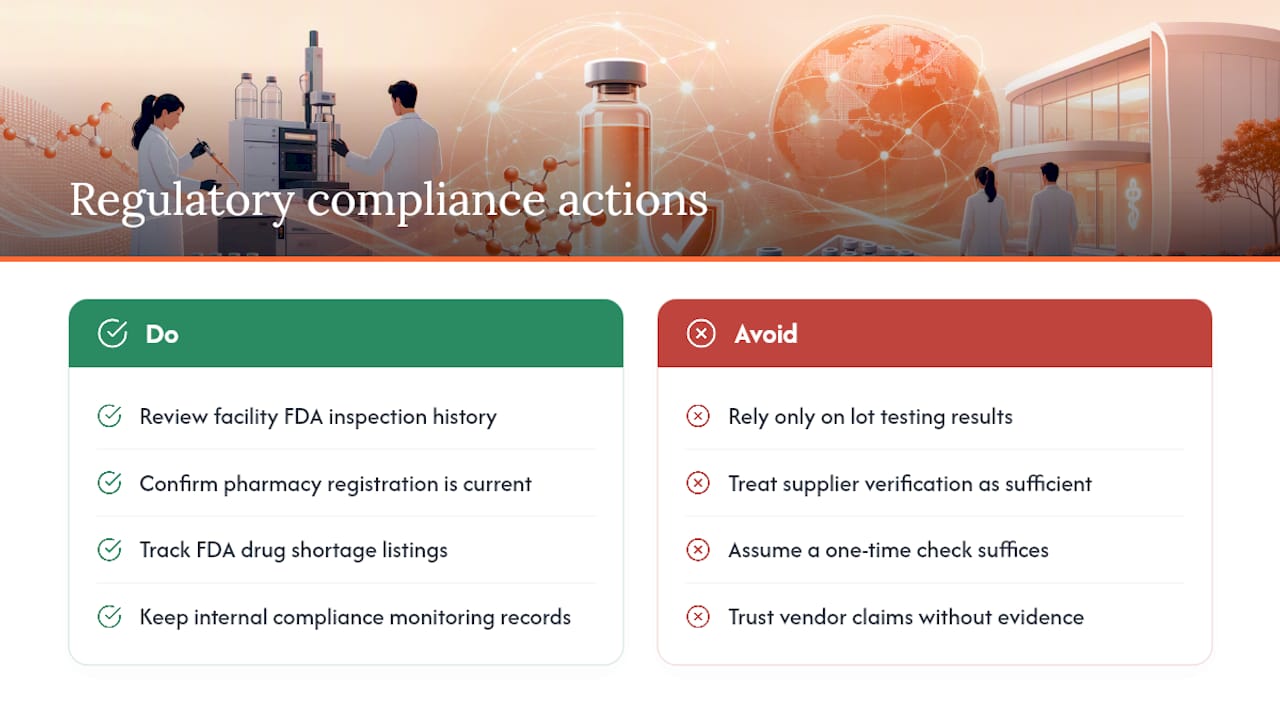
Supplier vetting handles one layer of risk. FDA oversight and Good Manufacturing Practice standards handle another, and clinics need both working together rather than treating supplier verification as the whole compliance picture.
503B outsourcing facilities operate under current Good Manufacturing Practice requirements, which govern facility conditions, equipment qualification, and process controls well beyond what a single COA can capture. A clinic relying solely on lot testing while ignoring whether the facility itself maintains GMP standing is missing half the picture, since a facility with lapsed GMP compliance can produce a batch that passes HPLC/MS testing today and still carries systemic quality risk.
FDA guidance on compounded drugs has tightened over recent years, particularly around peptides that overlap with high-demand categories like GLP-1 receptor agonists, where shortage-driven compounding has drawn increased scrutiny. Clinics should track whether a peptide they’re sourcing appears on any FDA drug shortage list, since compounding rules shift depending on shortage status.
Practical steps beyond supplier checks include reviewing a facility’s most recent FDA inspection history where publicly available, confirming the pharmacy’s registration status stays current rather than assuming a one-time check covers the relationship indefinitely, and keeping internal documentation that shows your clinic actively monitored compliance rather than passively trusted a vendor’s claims. Regulatory exposure in this space tends to fall on the prescribing and administering clinic just as much as the supplier, which is exactly why the professional guidance on peptide sourcing frames this as a shared liability rather than a vendor-only problem.
Risk Management: Counterfeits, Recalls, and What to Do When Something Goes Wrong
Counterfeit and diverted peptide product is a real risk in a market where legitimate pharmacy-grade supply and gray-market research chemicals sometimes travel through similar-looking packaging. The defense against this isn’t a single test. It’s a pattern of checks that make counterfeiting hard to hide.
Cross-referencing COA batch numbers against physical packaging catches the crudest counterfeits, where paperwork and product simply don’t match. More sophisticated counterfeiting requires independent lab confirmation, since a forged COA can look convincing on paper but won’t hold up against actual HPLC/MS testing of the physical sample. This is where sending a sample to independent testing, rather than trusting the vendor’s own lab exclusively, earns its cost.
Recall procedures need to be defined before you need them, not improvised during a crisis. A working recall protocol includes a way to identify every patient who received a given lot within minutes, a designated internal contact responsible for initiating supplier and regulatory notification, and a hold procedure for remaining stock from that lot pending investigation. Clinics that tie patient records to lot numbers at the point of administration, as covered in the documentation checklist earlier, are the ones who can execute this in an afternoon rather than a week.
Build a short internal escalation path too: who gets notified first, who contacts the supplier, and who determines whether affected patients need direct outreach. Write it down before the first recall, not during it.
What Clinical Peptide Sourcing Actually Costs
Compliant sourcing costs more than gray-market alternatives, and clinics should budget for that gap rather than treating price as the primary selection criterion. A 503A or 503B compounded peptide with full lot-specific COA documentation and validated cold-chain shipping carries overhead that an unlabeled research-grade vial simply doesn’t, because that overhead is the compliance infrastructure itself.
Budgeting should account for a few line items beyond the per-vial price: the cost premium of domestic or allied-country suppliers when geopolitical pressure or legislative action like the Biosecure Act pushes procurement away from certain international sources, the ongoing cost of periodic independent lab verification rather than relying solely on vendor-supplied COAs, and safety stock carrying costs when maintaining eight to twelve weeks of buffer inventory for critical peptides.
Clinics sometimes treat these as avoidable expenses. They’re better understood as the cost of staying inside a legal and clinically defensible sourcing model. A cheaper vial that can’t produce a lot-specific COA isn’t actually cheaper once you price in the liability exposure if that product is administered and something goes wrong.
Comparing pricing across verified vendors, rather than negotiating blind with a single supplier, is one of the more direct ways to keep this cost gap manageable without cutting corners on documentation. Real-time pricing comparison across pre-verified suppliers gives a clinic’s purchasing team a defensible basis for supplier selection that a single-quote negotiation doesn’t.
Ethical Sourcing Practices in Peptide Acquisition
Ethical sourcing in this category isn’t a separate checkbox from compliance. It’s largely the same discipline viewed from a different angle: transparency about origin, honest labeling, and refusal to participate in a supply chain that obscures where a peptide’s active ingredient actually came from.
A supplier that can’t or won’t disclose their manufacturing source, or that blends compounded pharmacy stock with relabeled research-grade material without disclosure, is engaged in a practice that’s both an ethical failure and a compliance risk. Clinics that knowingly source from opaque supply chains, even under price pressure, are accepting an ethical exposure alongside the regulatory one.
There’s also a patient-facing dimension. A patient receiving a compounded peptide has a reasonable expectation that the product was produced under pharmacy oversight with documented quality controls, not sourced through a distributor optimizing for margin over traceability. Honoring that expectation means clinics should be willing to explain, in plain terms, where a given peptide came from if a patient asks.
Ethical sourcing also touches how clinics handle supplier relationships during shortages. Hoarding scarce compounded stock, or pressuring a supplier to skip qualification steps to meet demand, shifts risk onto other clinics and patients further down the supply chain. Structured procurement, with qualified backup suppliers and documented safety stock, reduces the pressure that leads to those shortcuts in the first place.
Author Perspective: Why Procurement Culture Has to Change
Most clinics I’ve watched work through this problem didn’t have a bad supplier. They had no supplier vetting process at all, just a habit of reordering from whoever answered the phone fastest. That’s the real failure point, and it’s a cultural one before it’s a regulatory one.
Structured sourcing isn’t extra paperwork bolted onto clinical work. It’s the difference between a defensible decision and a guess dressed up as one. Clinics that build the checklist into their intake process, rather than treating it as a one-time onboarding hurdle, are the ones who catch problems before a patient is affected rather than after a recall notice arrives.
— Ross
How Peptide Vendor Reviews Fits Into Your Sourcing Workflow
Vetting a supplier’s compounding status is only half the job. Confirming what’s actually in the vial is the other half, and that’s the layer most clinics have no independent way to check without sending every lot to a lab themselves.
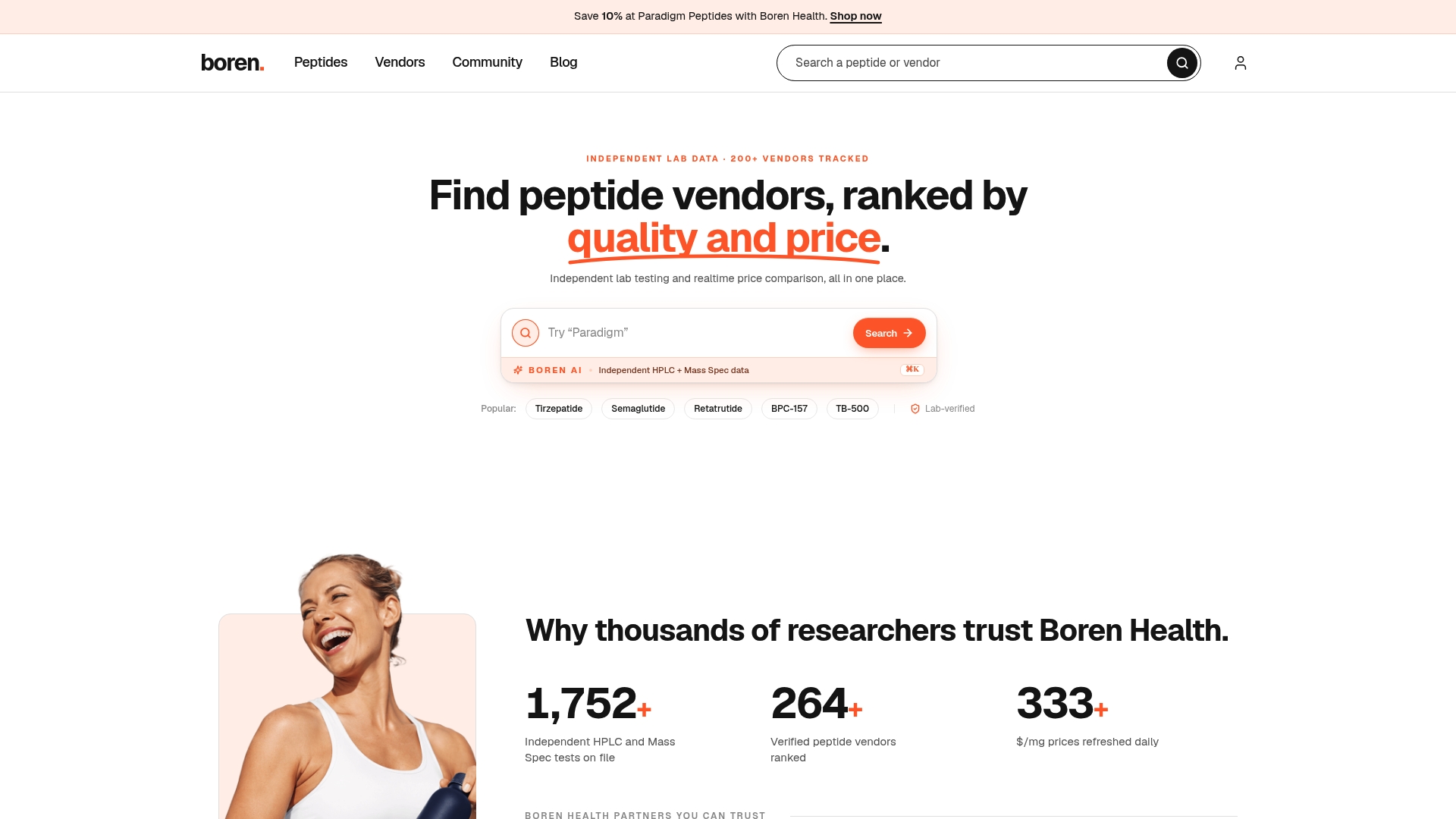
An independent platform can give clinics and research professionals lab data on peptides so vendor comparison doesn’t rely on a supplier’s own paperwork alone. The platform tracks over 200 verified vendors with real-time pricing, so procurement teams can compare cost against independently verified quality rather than choosing on price alone. Quality assessments can run through HPLC and mass spectrometry testing, providing clinics a purity score they didn’t generate in-house and don’t have to take on faith from the vendor selling the product.
If you’re evaluating a new supplier, start by searching that vendor on Peptide Vendor Reviews to see their existing lab-verified purity ranking. If a supplier isn’t listed yet, or you need confirmation on a specific lot before it goes into clinical use, the independent sample testing service gives you a third-party result to weigh against the vendor’s own COA. Build that check into your onboarding process once, and every future order from that vendor gets faster, not slower.
Sources
For direct regulatory grounding, review the professional statement on peptide sourcing on legal administration requirements, supply chain and logistics guidance on procurement workflow, and resilience strategies for peptide supply chains on qualifying backup suppliers. Check current legislative developments at Congress.gov and consult your state Board of Pharmacy directly for licensure verification.
- A Statement Regarding Peptide Sourcing
- Building A Resilient Supply Chain For Your Next-Generation Peptide Therapeutic
- Building a Resilient Global Peptide Supply Chain in 2026 | PeptideStaff
- Congress (search/act references)
FAQ
Who is the most reputable peptide supplier?
There’s no single “most reputable” supplier across the market. Reputable status depends on verified 503A/503B compounding status, current state Board of Pharmacy licensure, and lot-specific COAs with HPLC/MS confirmation, which is exactly why comparing suppliers against independently verified lab data through a tool like Peptide Vendor Reviews matters more than relying on a single vendor’s self-reported reputation.
Where do peptide sellers get their products?
Legitimate clinical suppliers source active pharmaceutical ingredients through registered manufacturers and compound them at 503A or 503B pharmacies under FDA and state oversight. Suppliers outside that pathway often source from research-chemical manufacturers producing RUO-labeled material never intended for clinical administration.
Which is the most reputable peptide company?
Reputability should be judged supplier by supplier and lot by lot, using confirmed compounding licensure and independently verified HPLC/MS results rather than brand recognition alone. A structured vendor comparison approach, checked against your state Board of Pharmacy, gives a more reliable answer than any single ranking.
Who are the best peptide vendors in the United States in 2026?
The strongest vendors for clinical use in 2026 are 503A or 503B compounding pharmacies with current state licensure, lot-specific COAs combining HPLC and MS, and documented cold-chain handling. Rather than a fixed list, clinics should verify each candidate vendor against these criteria directly, since licensing status and lab performance can change between orders.
What’s the difference between 503A and 503B for clinical peptide orders?
503A pharmacies compound patient-specific preparations against an individual prescription, while 503B outsourcing facilities compound in bulk under stricter FDA oversight without requiring a prescription per unit. Clinics ordering office-use stock typically need a 503B source; those filling individual patient prescriptions use 503A.