Require 99%+ Purity When Sourcing GLP-1 Peptides for Clinicians and Labs
Written by Jian Wang, Founder & CEO · · Updated
Only buy research-grade GLP-1 peptides that come with lot-specific certificates of analysis showing ≥99% HPLC purity and LC-MS identity confirmation. If a vendor cannot produce that documentation for the exact vial you’re ordering, walk away from the lot. Reliable GLP-1 peptide sourcing means treating each purchase as a verification exercise: check chromatograms, confirm cold-chain handling, and get import documentation squared away before money changes hands.
TL;DR:
- Only purchase research-grade GLP-1 peptides with lot-specific certificates confirming at least 99% HPLC purity and LC-MS identity verification.
- Verify vendor documentation matches the lot number, examine chromatograms for a single dominant peak, and request raw LC-MS data to ensure structural accuracy.
- Confirm shipping and storage practices include cold-chain handling, appropriate packaging, and proper freezing temperatures for lyophilized and reconstituted peptides.
- Use independent lab testing for critical lots and keep detailed records of lot numbers, COAs, and verification results to track manufacturing consistency over time.
- Be aware that tighter import regulations and potential counterfeit issues require thorough documentation, third-party testing, and vendor transparency before ordering.
Table of Contents
- Minimum Quality and Purity Criteria for GLP-1 Peptides
- How to Verify Vendor Quality: COAs, Third-Party Testing, and What to Inspect
- Regulatory, Import, and Shipping Considerations Researchers Must Check
- Practical Sourcing Workflow: Stepwise Procurement for GLP-1 Peptides
- Common Sources and Synthesis Methods of GLP-1 Peptides
- Standard Stability Testing Protocols for GLP-1 Peptides
- Typical Packaging Types and Their Impact on Peptide Integrity
- Risk Management for Counterfeit or Substandard GLP-1 Peptide Products
- How Independent Lab Data Changes the Sourcing Equation
- Verify Before You Buy: Peptide Vendor Reviews’s Approach to GLP-1 Sourcing
- Sources
- FAQ
Minimum Quality and Purity Criteria for GLP-1 Peptides
Purity below 99% doesn’t just mean “slightly less clean.” In receptor-binding assays, contaminating fragments and deamidated species compete for the same binding pocket as your target peptide, skewing EC50 values and making results hard to reproduce across labs. That’s why ≥99% HPLC purity paired with LC-MS identity confirmation has become the practical floor for research-grade GLP-1 analogs, a standard reflected across current supplier listings for semaglutide-class research material.
Purity is only half the picture. A peptide can hit 99% on a chromatogram and still carry the wrong structure if a synthesis step went sideways.
What to check beyond the purity number:
- C-terminal amide integrity is important because a hydrolyzed C-terminus can change receptor affinity even if the rest of the sequence is correct; fatty-acid conjugation status affects albumin binding behavior in semaglutide-class analogs; substitution sites common to GLP-1 mimetics confer enzyme resistance; and deamidation and truncation byproducts are common impurities that can alter potency without obvious purity changes.
Pro Tip: A peptide can pass HPLC at 99% purity and still fail your assay if the impurity is a close structural analog that co-elutes. Ask for LC-MS spectra, not just the HPLC trace.
Complete lot documentation preferably includes the lot number, a matching certificate of analysis (COA), the HPLC chromatogram, mass spectrometry data, moisture content usually measured by Karl Fischer titration, and counter-ion analysis. Vendors that build COAs this way, listing moisture and counter-ion results alongside identity confirmation, tend to be the ones with real quality-control infrastructure behind the product page.
How to Verify Vendor Quality: COAs, Third-Party Testing, and What to Inspect
A certificate of analysis is only useful if it belongs to the vial in front of you. Generic or “representative” COAs, unfortunately common in this market, tell you nothing about the batch you actually received.
Work through vendor documentation in this order:
- Match the lot number. Confirm the number on the COA matches the number printed on the vial and the number listed on your order confirmation. A mismatch here is disqualifying on its own.
- Read the HPLC chromatogram. Look for a single dominant peak at ≥99% area, with any secondary peaks clearly labeled and quantified rather than cropped out of the image.
- Check the LC-MS spectrum. The observed mass should match the expected molecular weight within a few Daltons. Vendors that pair HPLC purity with LC-MS identity confirmation give you both pieces of the puzzle, not just one.
- Request raw data when the stakes are high. For anything feeding into a publication or a preclinical program, ask the vendor for the original chromatogram file, not a screenshot. A vendor that hesitates here is telling you something.
- Decide whether to verify independently. For critical experiments, run your own HPLC/LC-MS confirmation in-house or send a sample to a third-party lab before committing to bulk quantities.
Pro Tip: Keep a running spreadsheet of lot numbers and their COAs across every vendor you use. When a result doesn’t replicate months later, you’ll want to trace it back to the exact batch, not just the product name.
Red flags worth memorizing: COAs that aren’t tied to a specific lot, missing mass spectrometry data, storage claims that contradict the peptide’s known stability profile, and pricing that sits far below the rest of the market with no explanation.
Regulatory, Import, and Shipping Considerations Researchers Must Check
Procurement problems rarely start with the peptide itself. They start with paperwork. Since September 2025, U.S. importation of GLP-1 bulk drug substances has faced tighter FDA import scrutiny, so confirming a manufacturer’s recognition status before ordering internationally has become a necessary step rather than a formality.
Before you place an order, work through these checks:
- Confirm the supplier can produce origin and manufacturing documentation that satisfies your country’s import requirements.
- Verify the product is labeled research-use-only, and check that this matches your institution’s compliance policy for non-clinical materials, since research-use-only disclaimers are commonly present across suppliers.
- Ask how the peptide ships. Lyophilized powder should travel with adequate insulation, and reputable EU suppliers now advertise fast regional dispatch specifically to shorten the cold-chain exposure window.
- Store lyophilized powder at -20°C and reconstituted aliquots at -80°C, using single-use aliquots to avoid repeated freeze-thaw cycles that degrade peptide integrity.
- Build lead times into your project timeline. International shipments carrying temperature-sensitive biologics rarely move as fast as domestic ones.
Practical Sourcing Workflow: Stepwise Procurement for GLP-1 Peptides
Treat vendor selection as a funnel, not a single decision. Here’s the sequence that keeps risk manageable at every stage:
- Shortlist by documentation quality. Eliminate any vendor that can’t show a sample COA, a chromatogram, or published purity specs before you even request a quote.
- Order a pilot lot. For any peptide feeding a critical assay, buy the smallest available quantity first and run your own acceptance testing against the vendor’s claims.
- Confirm shipping SOPs before scaling up. Ask directly about cold-chain packaging, carrier choice, and realistic lead times. Get this in writing before placing a bulk order.
- Log every lot number and COA. Build a simple tracking system, and schedule periodic re-testing for peptides you’ll be ordering repeatedly over months, since manufacturing consistency can drift between production runs.
Pro Tip: Budget for sample testing as a line item, not an afterthought. Third-party HPLC/LC-MS verification typically adds days to your timeline and a modest cost per sample, but it’s cheap insurance against a failed six-month study built on a bad lot.
Turnaround for independent verification varies by lab and method, so build a buffer into your project calendar rather than assuming next-day results. The cost of that buffer is trivial next to the cost of re-running an experiment because the peptide wasn’t what the label said.
Common Sources and Synthesis Methods of GLP-1 Peptides
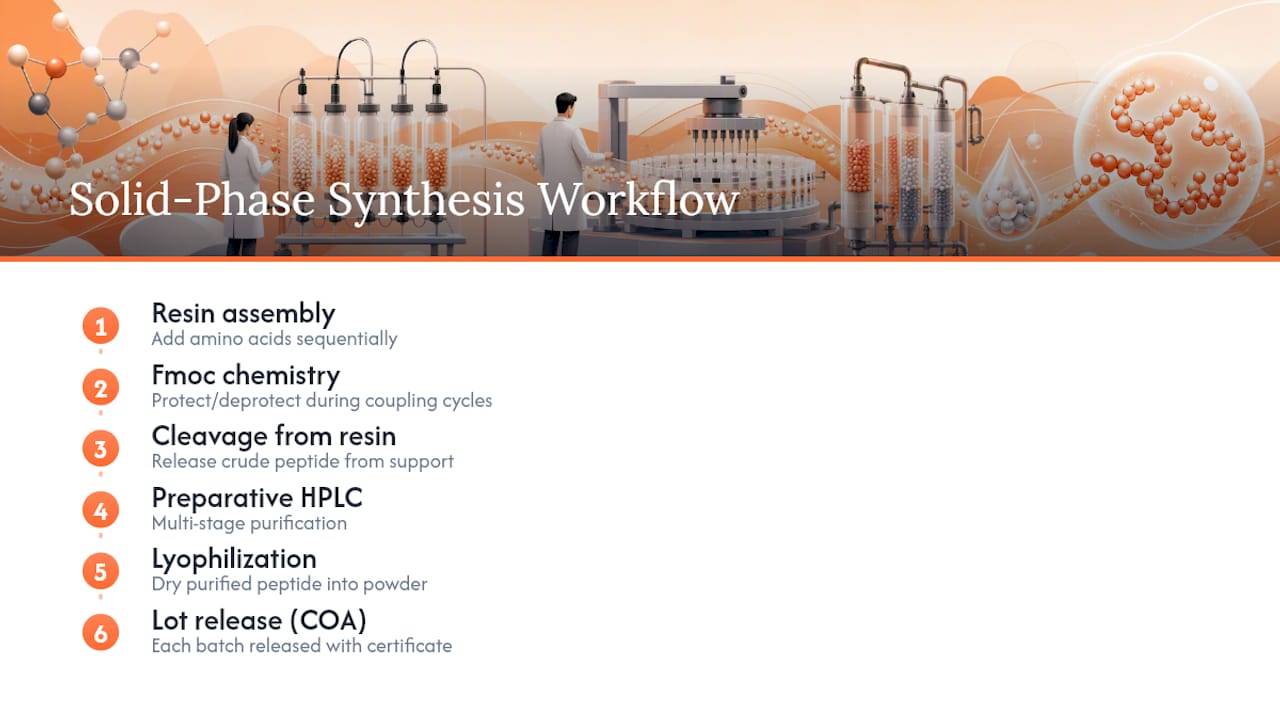
Research-grade GLP-1 analogs, including semaglutide and tirzepatide-class peptides, are almost universally produced using solid-phase peptide synthesis, typically Fmoc chemistry, followed by multi-stage purification and lot release against a certificate of analysis. Manufacturers build the peptide chain on a solid resin support one amino acid at a time, then cleave, purify via preparative HPLC, and lyophilize the final product before releasing each production lot against its own COA.
Sourcing generally falls into three categories. Specialized peptide synthesis houses handle custom orders and larger-scale production runs, often advertising the ability to adjust purity level and batch size depending on the application; a synthesis partner like Mayflower Bioscience illustrates how tailored peptide production works for discovery-stage research. Catalog suppliers stock standard GLP-1 analogs as ready-to-ship SKUs, which is faster but leaves less room for custom modifications. Academic or contract research labs sometimes synthesize peptides in-house for highly specific structural variants that aren’t commercially available.
Not every application needs the same purity tier. Some synthesis providers explicitly offer a range of purities, from 95% up through 99%, since exploratory screening work can tolerate impurity levels that would compromise a definitive pharmacology study. Knowing which tier your experiment actually requires saves money without cutting corners where it matters.
Standard Stability Testing Protocols for GLP-1 Peptides
Stability data tells you how long a peptide stays intact under specific storage conditions, and it should factor into every sourcing decision involving anything beyond immediate use. Reputable suppliers typically validate stability across a few standard conditions: long-term storage at the recommended freezer temperature, accelerated stress testing at elevated temperatures to model degradation kinetics, and reconstituted-solution stability over days to weeks under refrigeration.
For GLP-1 peptides specifically, the two failure modes to watch are deamidation, which accelerates at higher temperatures and in aqueous solution, and aggregation, more relevant for fatty-acid-conjugated semaglutide-class molecules due to their amphiphilic structure. A vendor with a real quality system will document how purity and identity hold up over time, not just at the moment of release.
Ask suppliers directly for stability data covering the exact formulation you’re ordering; lyophilized powder and reconstituted solution age at dramatically different rates. If a vendor can’t answer basic questions about degradation over a defined storage window, treat that as a gap in their quality infrastructure, not just a documentation oversight. Building your own accelerated-stability check into your lab’s acceptance protocol, even a simple HPLC re-check at 30 and 60 days post-reconstitution, closes that gap when the vendor won’t.
Typical Packaging Types and Their Impact on Peptide Integrity
Packaging isn’t cosmetic. It’s the last line of defense between a correctly synthesized peptide and a degraded one by the time it reaches your bench.
Most research-grade GLP-1 peptides ship as lyophilized powder in sealed glass vials, often under inert gas or vacuum-sealed to limit moisture exposure. That matters because atmospheric moisture accelerates hydrolysis and deamidation, the same degradation pathway that shows up as an unexpected shoulder peak on a later HPLC run. Amber or light-protected vials matter for peptides sensitive to photodegradation, though most GLP-1 analogs are more moisture-sensitive than light-sensitive.
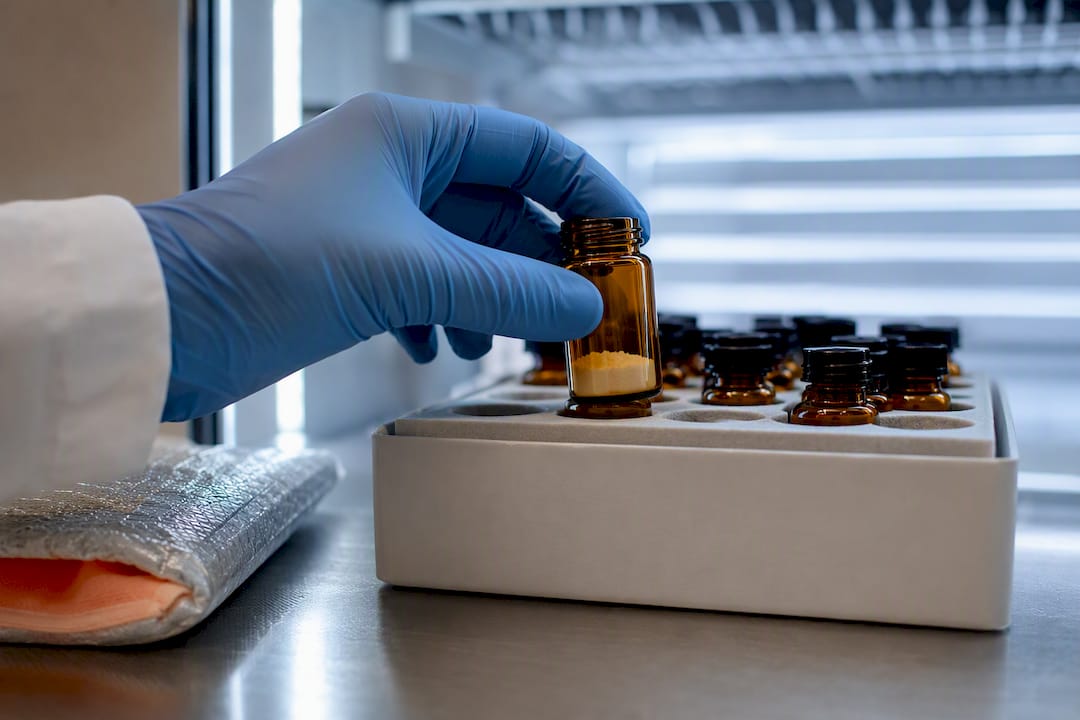
Shipping packaging is a separate concern from vial packaging. Insulated containers with phase-change cooling packs or dry ice maintain cold-chain integrity in transit, and the difference between a well-packed shipment and a poorly packed one often shows up only after reconstitution, when a peptide that should behave predictably in an assay instead gives inconsistent results. Once reconstituted, single-use aliquots stored in appropriately sized tubes prevent the repeated freeze-thaw cycling that degrades peptide structure over successive uses.
Ask any new vendor how they package both the vial and the shipment. A supplier that can describe their moisture-control and cold-chain approach in specific terms is generally a supplier that has thought about integrity past the point of sale.
Risk Management for Counterfeit or Substandard GLP-1 Peptide Products
Counterfeit and substandard peptides don’t usually announce themselves. They show up as an assay that won’t replicate, a binding curve that looks slightly off, or a batch that behaves differently from the last one you ordered from the same supplier name.
The most effective defense is structural: never accept a COA that isn’t tied to the specific lot number on your vial, and treat mismatched or generic documentation as an automatic disqualifier regardless of price or vendor reputation. Requiring lot-specific chromatograms and mass spectrometry spectra before committing to a bulk order catches most mislabeling problems before they become a research problem.
Price is a secondary signal worth watching. Neither scenario ends well for your data.
Diversifying supply and independently verifying at least a subset of incoming lots, rather than trusting every batch from a single vendor indefinitely, limits your exposure when one supplier’s quality control slips. Manufacturing consistency drifts over time even at reputable houses, and periodic spot-checks catch that drift before it contaminates months of accumulated data.
How Independent Lab Data Changes the Sourcing Equation
The GLP-1 peptide market has a structural trust problem, and it isn’t going away. Vendors write their own product pages, grade their own purity, and have every incentive to present their COAs in the most favorable light. That’s not necessarily dishonesty; it’s just how a largely unregulated research supply market works when nobody outside the vendor is checking the work.
What actually changes the risk calculus is independent verification that sits outside the vendor’s own claims. When lot-specific HPLC and mass spectrometry results come from a third party rather than the seller, mislabeling and quality drift get caught before they wreck a six-month study. Pairing that independent data with transparent, lot-level pricing across many vendors, rather than trusting one supplier’s word indefinitely, is the single biggest lever researchers have to reduce sourcing risk without slowing procurement to a crawl.
— Ross
Verify Before You Buy: Peptide Vendor Reviews’s Approach to GLP-1 Sourcing
Most researchers piece together vendor trust from scattered product pages, forum threads, and whatever COA happens to be attached to that week’s listing. Peptide Vendor Reviews replaces that guesswork with a single comparison layer built on independent lab data.
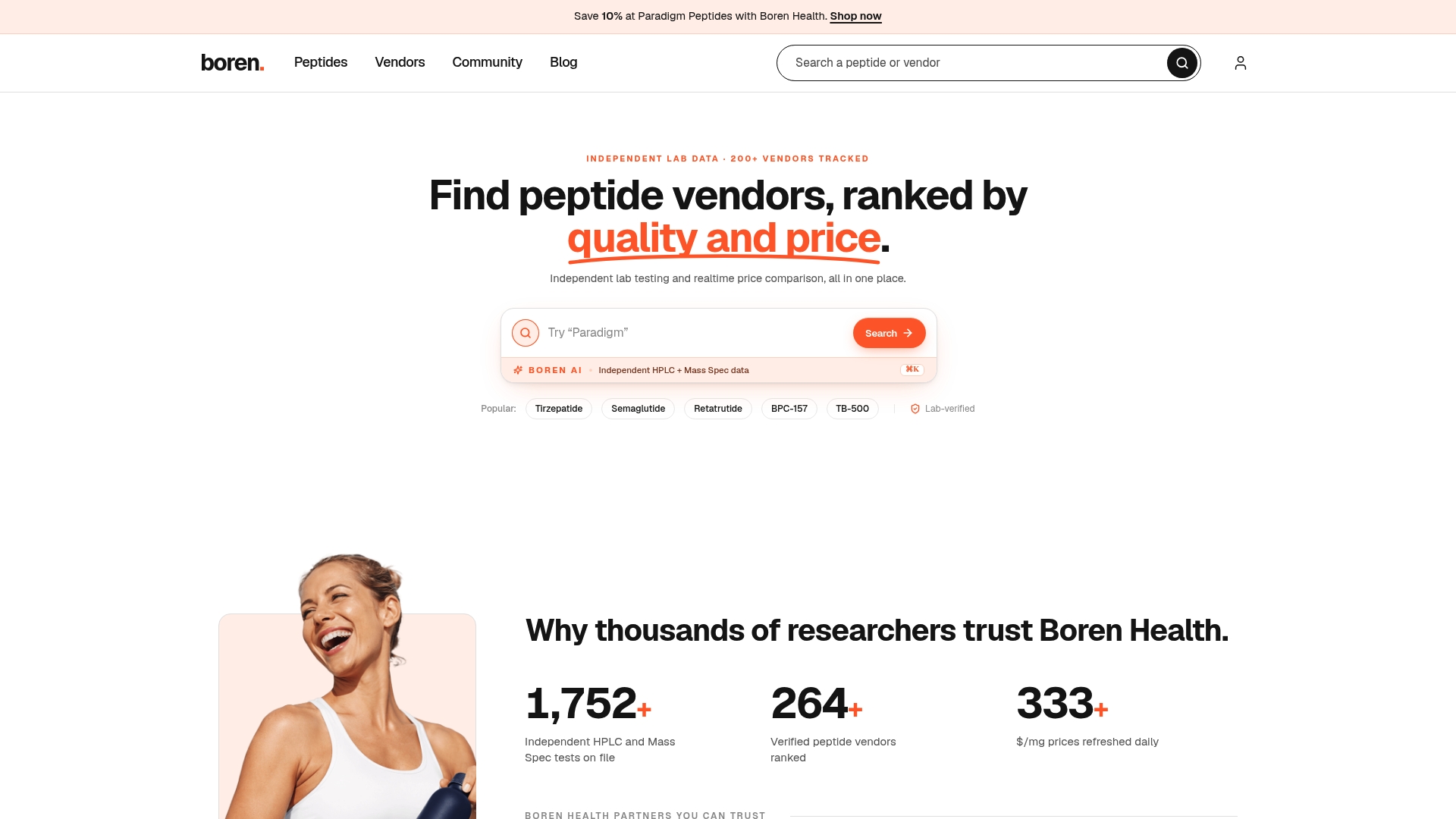
The platform aggregates lot-specific COAs, HPLC and mass spectrometry results, and verified buyer reviews across peptide vendors selling Tirzepatide, Semaglutide, and related GLP-1 analogs, with pricing that updates regularly so you’re not comparing stale numbers against a current quote. That means you can check a vendor’s purity claims against independent lab results before you ever place an order, rather than after a failed assay forces the question.
For peptides feeding a critical experiment, Peptide Vendor Reviews’s sample testing service lets you send a lot for independent verification before committing to a bulk purchase. Start by comparing verified vendors on the peptide vendor comparison page, and check lab-backed purity data before your next order.
Sources
Vendor product pages remain the most direct source for COA formats and stated purity levels, including listings for semaglutide analogs at ≥99% HPLC purity with published molecular specifications. For storage and handling guidance specific to lyophilized GLP-1 research material, EU supplier documentation on batch verification and cold-chain practices offers a practical reference point for procurement teams building their own acceptance criteria.
This article is general information, not a substitute for advice from a qualified doctor. Consult a qualified healthcare professional about your own circumstances before acting on anything here.
FAQ
Why does LC-MS identity confirmation matter alongside HPLC purity?
HPLC confirms how clean a sample is, but LC-MS confirms it’s structurally the right molecule; a peptide can show a clean HPLC peak while carrying a mass shift from deamidation or truncation that only mass spectrometry catches.
Are GLP-1 research peptides legal to purchase?
Research-use-only GLP-1 peptides are widely sold for laboratory and analytical work, but they carry explicit non-clinical labeling, and importing them, especially into the U.S. since tighter 2025 FDA restrictions on bulk drug substances, requires checking manufacturer recognition and documentation for your specific case.
How should reconstituted GLP-1 peptides be stored?
Store lyophilized powder at -20°C and reconstituted aliquots at -80°C, using single-use aliquots to avoid repeated freeze-thaw cycles that degrade the peptide.
Can Peptide Vendor Reviews verify a vendor’s purity claims before I order?
Yes. Peptide Vendor Reviews compares lot-specific COAs, HPLC and mass spectrometry data, and verified buyer reviews across many vendors, and its sample testing service allows independent verification of a lot before a bulk purchase.