Price vs Purity: Buy Peptides by Usable Milligram, Not Sticker Purity
Written by Jian Wang, Founder & CEO · · Updated
A peptide’s sticker purity percentage should never decide a purchase on its own. What decides it is a batch-specific Certificate of Analysis (COA) that includes an HPLC chromatogram, mass spectrometry confirmation, and net peptide content for that exact lot. Paying a premium is justified when a study depends on precise molar concentration; a cheaper, HPLC-only peptide can be acceptable for early screening, as long as you understand what you’re not getting.
TL;DR:
- Peptides labeled as 98% purity based on HPLC alone may contain only 70 to 80% active peptide by mass once TFA salt and moisture are considered.
- Batch-specific COAs with mass spectrometry and net peptide content analysis are essential for accurate assessment and proper dosing, especially in precise studies.
- Higher verification tiers, including third-party testing and amino acid analysis, cost three to four times more but significantly reduce the risk of impurities affecting results.
- Comparing vendors based on verified net peptide content per dollar provides a more accurate measure of value than sticker price or claimed purity alone.
- An order’s legitimacy depends on detailed documentation, including lot-specific COAs, mismatch verification, and proper storage, rather than price or marketing claims.
Table of Contents
- Price vs. Purity Peptides: What “98% Pure” Actually Means
- How Pricing Maps to Quality in Peptide Synthesis
- How Do You Verify a Peptide Vendor Is Legitimate?
- When Should You Pay More for Higher Peptide Purity?
- What Independent Lab Data Reveals About Peptide Quality
- An Editorial Note on Cost, Proof, and Reproducibility
- Compare Price, Purity, and Proof Before You Order
- Sources
- FAQ
Price vs. Purity Peptides: What “98% Pure” Actually Means
The number printed on a vendor’s label almost always refers to HPLC area percent, not the actual amount of active peptide by weight. Those are two different measurements answering two different questions, and confusing them is the single most common procurement mistake in peptide sourcing.
HPLC area percent measures the relative size of one peak against all other peaks in a chromatogram. It tells you how clean the sample looks compared to itself. It does not tell you what fraction of the vial’s mass is actually your peptide, because it says nothing about counterions, bound water, or residual solvents sitting alongside the peptide backbone.
Intact-mass mass spectrometry (MS) and MS/MS answer a different question entirely: identity. MS confirms the molecule in the vial has the correct molecular weight and sequence, catching problems like truncated synthesis, deamidation, or oxidation that an HPLC trace alone might miss or misrepresent as a “pure” peak.
Net peptide content, usually measured through amino acid analysis (AAA) or nitrogen analysis, is the number researchers actually need. It expresses the true percentage of active peptide by mass, after accounting for everything else in the vial. This is where most of the gap between “purity” and reality lives.
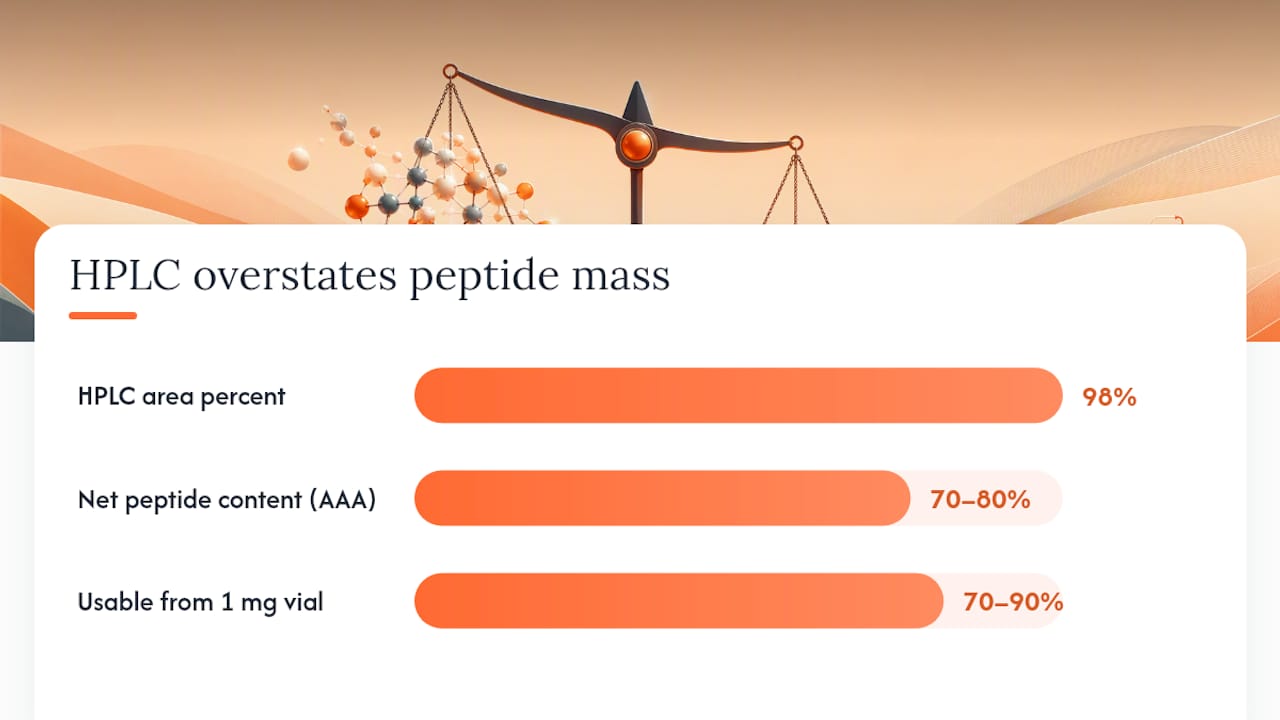
Trifluoroacetic acid (TFA) counterions are the biggest hidden factor. Peptides synthesized and purified using TFA buffers retain TFA salt as part of their final mass, and that salt contributes nothing to biological activity. Multiple basic residues in a sequence can bind more TFA, and combined with residual moisture from lyophilization, net peptide content is often substantially lower than the HPLC area percent.
A 98% HPLC-area purity claim can correspond to only about 70 to 80% peptide by actual mass. A vial labeled “1 mg” might contain closer to 0.7 to 0.9 mg of usable peptide once TFA content and moisture are factored in. For a dose-response curve where molar concentration matters, that gap changes your results, not just your accounting.
Other assays matter for specific applications, even though they rarely make it onto a basic COA:
- Endotoxin testing matters for any in vivo work or cell-based assay sensitive to inflammatory contamination.
- Sterility testing matters for injectable research applications or long-term cell culture work.
- Residual solvent analysis matters when downstream chemistry or formulation is sensitive to trace acetonitrile or DMF.
- Counterion identification (TFA versus acetate versus hydrochloride) matters whenever you need an accurate molar concentration.
A peer-reviewed methodology review makes the same point plainly: HPLC area percent and content/assay results are not interchangeable, and characterizing a peptide properly requires combining several complementary tests rather than leaning on one number.
How Pricing Maps to Quality in Peptide Synthesis
Peptide pricing follows a fairly predictable logic once you know what to look for, and most of it traces back to how much analytical work happened after synthesis, not just the synthesis itself.
Sequence length and complexity set the baseline. Longer chains, sequences with difficult couplings, and peptides requiring cyclization or unusual modifications all cost more to synthesize before purity even enters the picture. A 5-residue peptide and a 40-residue peptide are not competing in the same cost bracket regardless of purity claims.
Purification depth is where the real price divergence happens. Getting from crude peptide to 85% HPLC purity is a different process than pushing from 95% to 98% or 99%. Each additional purification pass, tighter gradient run, or repeated preparative HPLC cycle removes progressively smaller amounts of impurity for progressively higher cost. Institutional peptide cores that publish their own fee schedules illustrate this directly: purification and analysis fees scale with the purity target requested, not with the peptide’s length alone.
Verification steps add a separate, often underpriced, cost layer. Counterion exchange (swapping TFA for acetate, for instance), amino acid analysis, third-party mass spec confirmation, and cold-chain lyophilization and shipping all add measurable premiums on top of purification. Industry pricing analysis suggests verified, third-party-tested peptides commonly run 3 to 4 times the price of unverified alternatives, largely because that verification work is labor-intensive and requires outside lab time.
Three rough tiers tend to show up across the market:
- Budget tier (HPLC-only): Cheapest option, purity claim unverified by MS or content assay, and often the vendor’s own in-house HPLC run without third-party confirmation.
- Verified tier (HPLC plus MS): Mid-range pricing, identity confirmed, but net peptide content may still be estimated rather than directly measured.
- Publication-grade tier (HPLC plus MS plus AAA plus third-party COA): Highest price, but every number on the COA is independently confirmed and traceable to a specific lot.
Pro Tip: Stop comparing price per milligram of listed peptide and start comparing price per usable milligram, calculated by multiplying vial weight by net peptide content. A $90 vial at 75% net content costs more per usable milligram than a $110 vial at 95% net content, even though the sticker price says otherwise.
A supplier comparison analysis reaches a similar conclusion: the economically optimal choice for most labs is a moderate price paired with strong proof, not the cheapest listing and not the highest sticker purity sold without documentation.
How Do You Verify a Peptide Vendor Is Legitimate?
Price tells you almost nothing about legitimacy on its own. A testing guide from PepGuide puts it directly: price is the most visible number on a listing and also the easiest one to manipulate, which is exactly why it should never be your first filter. Documentation should be.
Run through this sequence before committing to a full order:
- Request the batch-specific COA for the exact lot you’re buying, including the raw HPLC chromatogram and intact-mass MS data, not a generic template pulled from the product page.
- Confirm the lot number printed on the vial matches the lot number on the COA and, ideally, matches an archived record the vendor can produce on request.
- Check net peptide content and counterion type explicitly. If the vendor can’t tell you whether the peptide is a TFA salt or an acetate salt, ask for amino acid analysis before you order in volume.
- Favor vendors using named, accredited third-party labs over in-house-only testing, and check that the COA lists a date of analysis and lab contact information you could actually follow up on.
- Confirm cold-chain shipping and storage practices, including whether the peptide ships with desiccant, under inert gas, and lyophilized rather than in solution, plus what the vendor’s return or retest policy looks like if a lot fails your own QC.
- Run in-house verification on a test vial when the application justifies it. A quick RP-HPLC run on receipt catches degraded or mislabeled lots before they enter a multi-week study.
This sequence tracks closely with published procurement guidance: prioritizing batch-specific COAs, lot traceability, and net peptide content over label claims is the differentiator between vendors worth repeat business and vendors worth avoiding.
Pro Tip: Ask for the COA before you ask for the price quote. A vendor’s response time and willingness to produce lot-specific documentation tells you more about their legitimacy than anything on their pricing page.
Remember that “research use only” language on a label is a commercial disclaimer, not a quality guarantee. FDA guidance on compounding and research-use materials makes clear that RUO peptides fall outside the regulatory oversight applied to pharmaceutical products, so any purity or identity claim on an RUO label is the vendor’s own representation, not a government-verified standard.
When Should You Pay More for Higher Peptide Purity?
Not every experiment needs publication-grade documentation, and paying for it when you don’t need it just burns budget you could spend on replicates instead.
Map the purchase to the actual research tier:
- Method development or initial screening: HPLC-only purity is often acceptable. You’re establishing feasibility, not reporting a final result, and a lower-cost peptide lets you iterate faster.
- ELISA or Western blot work: HPLC plus basic MS confirmation is a reasonable minimum, since identity matters more than exact molar precision at this stage.
- Cell-based quantitative assays: HPLC plus MS plus net peptide content becomes important once your readout depends on a specific concentration curve rather than a presence/absence result.
- In vivo dosing studies: Full documentation, including AAA and third-party verification, is close to mandatory. Dosing errors from unknown net content compound across every animal in the study.
- Structural biology or biophysical characterization: Publication-grade proof across every category is the only defensible standard, since structural conclusions are only as good as the sample’s confirmed identity and purity.
A useful heuristic cuts through most of the ambiguity: if the experiment’s outcome depends on knowing the exact molar concentration in solution, net peptide content and MS confirmation are non-negotiable. If the experiment only needs to detect presence or general activity, HPLC purity alone may be defensible.
The cost of skipping this step is not hypothetical. Industry analysis has found that up to roughly 38% of research-grade peptides tested in some reviews contained impurities exceeding 5%, which is more than enough to distort a dose-response curve or invalidate a reproducibility check months into a project. A failed run at that stage costs far more in lost time and repeat purchases than the price difference between a verified and unverified vial ever would have.
What Independent Lab Data Reveals About Peptide Quality
Running independent HPLC and MS testing across vendors surfaces patterns that sticker purity claims consistently hide. The most common finding isn’t outright fraud. It’s a gap between what a listing advertises and what the lot actually contains once counterions, degradation, and synthesis shortcuts are accounted for.
A peptide marketed at 98% purity with no MS data and no net content figure is, functionally, an unverified claim regardless of how confidently it’s stated. Lab-verified COAs close that gap by attaching real chromatogram data and mass confirmation to a specific lot, which is what allows a researcher to calculate an honest price-per-usable-milligram figure instead of comparing sticker prices side by side.
Two patterns show up repeatedly in procurement decisions built around this kind of verification:
- A researcher comparing two similarly priced vendors for the same peptide finds that one’s lab-verified net content runs 15 to 20 percentage points below the other, even though both list the same HPLC purity on their websites. Choosing the higher-verified-content vendor, despite a marginally higher sticker price, ends up cheaper per usable milligram.
- A lab preparing a dose-response study checks lot-specific MS data before ordering and discovers the vendor’s current batch shows a mass shift consistent with partial oxidation, something the HPLC trace alone didn’t flag. Catching it before the order ships avoids a multi-week study built on a compromised lot.
Daily price tracking layered on top of this lab data turns “which vendor is cheapest” into “which vendor is cheapest per verified milligram,” which is the number that actually matters for a research budget.
An Editorial Note on Cost, Proof, and Reproducibility
Peptide procurement should run on documentation, not on the confidence with which a purity number is printed. That’s the whole argument of this piece, and it holds regardless of budget size or lab prestige.
Archive every COA and lot number you receive, not just for the peptides you’re currently running, but for anything that might end up in a publication or an audit years later. Reviewers and auditors ask for traceability long after the vial is empty, and “the vendor said 98%” is not an answer anyone accepts.
— Ross
Compare Price, Purity, and Proof Before You Order
Peptide Vendor Reviews exists because sticker purity and vendor marketing tell you almost nothing about what’s actually in the vial. The platform runs independent HPLC and mass spectrometry testing across more than 200 vendors, publishes daily price updates, and lets you check lab-verified net peptide content before you spend a dollar, instead of after a failed dose-response run tells you something was wrong.
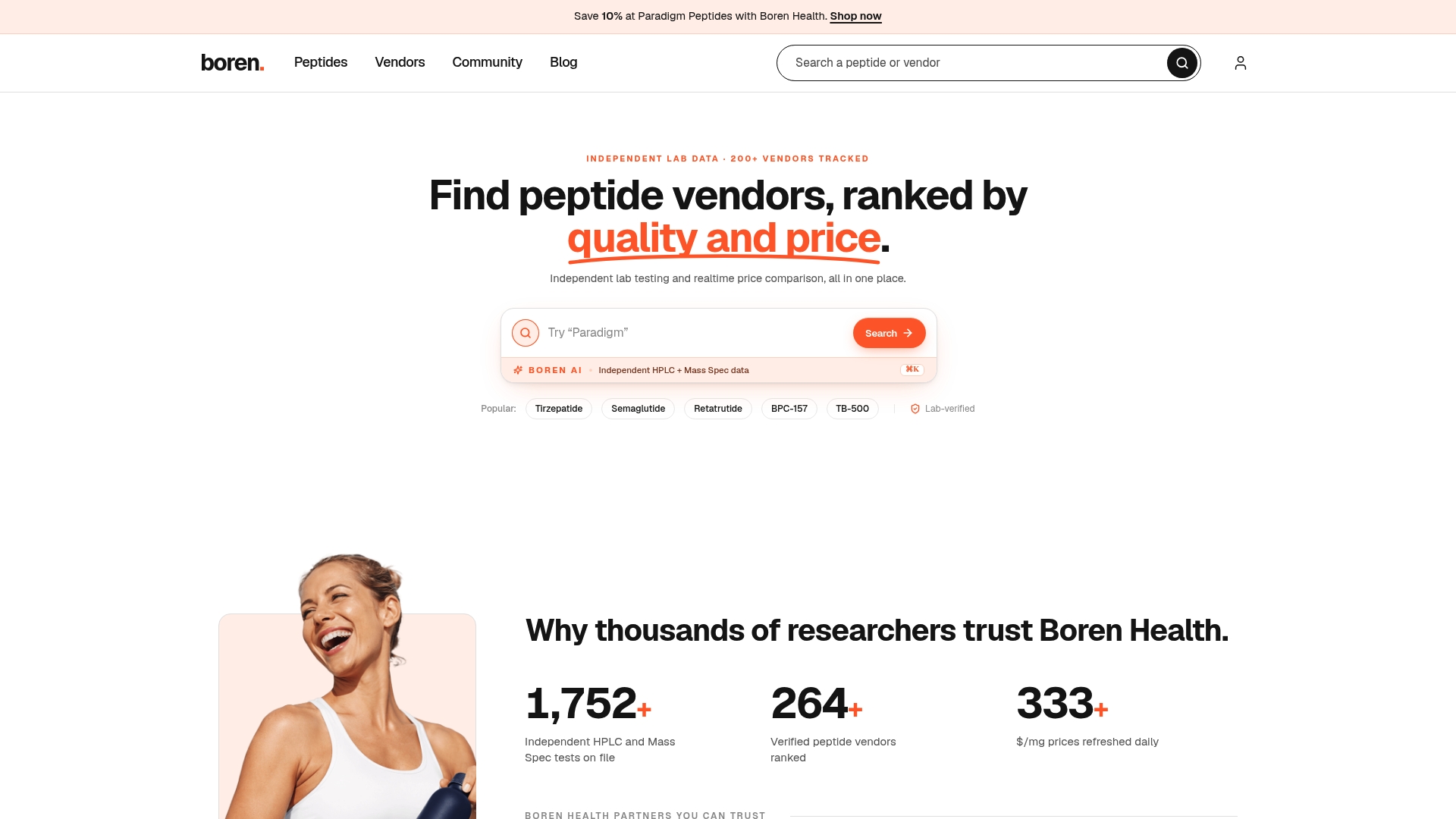
Use the vendor comparison tool to calculate price-per-usable-milligram across suppliers carrying the peptide you need, whether that’s Tirzepatide, Semaglutide, or another compound on the platform. If you’ve already purchased a lot and want independent confirmation before committing it to a critical experiment, the test-my-sample service runs third-party HPLC and MS analysis on the exact vial you received. For labs sourcing in bulk, wholesale suppliers like VantaPept are worth checking against Peptide Vendor Reviews’s verified pricing data before placing a large order. Start with the vendor comparison page and see how your current supplier’s documentation stacks up.
Sources
FAQ
What Is the Most Legitimate Peptide Company?
There’s no single “most legitimate” vendor across the entire market. Legitimacy comes down to whether a specific vendor provides batch-specific COAs with HPLC and MS data for the exact lot you’re buying, which is why comparing verified documentation across vendors matters more than reputation alone.
Are High-Purity Peptides Legitimate?
A high purity claim is only as legitimate as the documentation behind it. An HPLC-only claim of high purity without MS confirmation or net peptide content is unverified, while the same claim backed by a batch-specific COA and third-party testing is trustworthy.
Is 98% Purity Good for a Peptide?
98% HPLC area percent is a strong starting signal, but it can correspond to only about 70 to 80% actual peptide content by mass once TFA counterions and moisture are accounted for.
What Peptides Does Jennifer Aniston Take?
There’s no verified, publicly documented list of specific peptides tied to Jennifer Aniston, and celebrity wellness claims of this kind are not a reliable basis for research or procurement decisions. Base sourcing choices on lab-verified data for the specific compound you need, such as Tirzepatide or Semaglutide comparisons on Peptide Vendor Reviews, rather than unverified celebrity attribution.