2026 Enforcement and PCAC Votes: U.S. Researchers' Peptide Checklist
Written by Jian Wang, Founder & CEO · · Updated
2026 Enforcement and PCAC Votes: U.S. Researchers’ Peptide Checklist
Short answer: most research peptides are not controlled substances under federal drug scheduling, but many are unapproved new drugs under the FD&C Act, which makes selling or using them in humans unlawful in most cases. The FDA and its advisory body, the Pharmacy Compounding Advisory Committee (PCAC), have been actively reshaping the gray zone around peptides like BPC-157 and CJC-1295 throughout 2026, while approved drugs like semaglutide and tirzepatide sit in a completely different legal category. None of that advisory activity has changed federal law yet.
TL;DR:
- Most research peptides are considered unapproved new drugs under the FD&C Act and are illegal to sell or use in humans without proper authorization.
- Marketing signals such as dosing suggestions, testimonials, bundling with injection supplies, or references to therapeutic benefits are key triggers for FDA enforcement actions.
- The “Research Use Only” label does not provide legal protection when peptides are sold or marketed for human injection, especially if accompanied by dosing info or personal results.
- FDA advisory committee votes on peptides are only recommendations; formal rulemaking and approval are still required before they can be legally marketed for human use.
- Buyers should verify the peptide source by requesting current Certificates of Analysis, confirming manufacturer registration, and ensuring institutional oversight when applicable.
Table of Contents
- Understanding Peptide Legality Under the FD&C Act
- What “Research Use Only” Labeling Actually Covers
- Compounding Rules: 503A, 503B, and PCAC’s Advisory Role
- How the FDA and States Are Actually Enforcing the Rules
- Approved Medicines vs. Common Research Peptides: Know the Difference
- A Practical Compliance Checklist for Sourcing Peptides
- Why the Headlines About Peptide “Approval” Miss the Point
- Sources
Understanding Peptide Legality Under the FD&C Act
The Federal Food, Drug, and Cosmetic Act defines a “drug” partly by intended use, not by chemical structure. A peptide becomes a regulated drug the moment someone markets it, sells it, or talks about it in a way that suggests it treats, prevents, or affects a person’s body. That’s the entire legal hinge of research peptides legality: intent, not ingredient.
The FDA doesn’t need a company to say “this treats injuries.” Agency warning letters routinely point to indirect signals: dosing charts, before-and-after testimonials, blog posts describing recovery benefits, or product bundling with bacteriostatic water and syringes. Put those pieces together, and a “research use only” peptide starts looking, to a regulator, exactly like an unapproved drug marketed for human use.
Specific triggers the FDA has flagged in enforcement actions include:
- Suggested dosing amounts or injection frequency on a website or label
- Customer testimonials describing physical effects or results
- Bundling peptides with needles, alcohol swabs, or reconstitution water
- Blog content or social posts referencing therapeutic or performance benefits
- Comparisons to FDA-approved drugs (implying similar effects without approval)
FDA warning letters issued in March 2026 cited exactly this pattern: sellers whose marketing language, despite disclaimers, established a clear human-use intent under FDA’s bulk drug substance compounding rules. The disclaimer on the label almost never wins that argument.
What “Research Use Only” Labeling Actually Covers
“Research Use Only” sounds like a legal safe harbor. It isn’t one, at least not for injectable peptides sold to individual buyers.
The RUO designation comes from 21 CFR 809.10, a regulation written for in vitro diagnostic devices, things like lab reagents and test kits, not injectable compounds intended for the human body. Applying an RUO label to a peptide vial doesn’t import any of that regulation’s protections. It’s a phrase borrowed from an unrelated corner of federal law, and the FDA treats it as decoration rather than a legal classification.
Here’s how vendors typically undercut their own RUO claims, often without realizing it:
- They publish reconstitution instructions specific to human dosing, not lab use.
- They accept and display customer reviews describing personal results.
- They sell peptides alongside insulin syringes and bacteriostatic water, kits clearly built for injection, not bench science.
Each of those choices tells the FDA, and potentially state boards, that the “research” framing is cosmetic. Add cross-border shipping into the mix, and importation rules add another layer of exposure, since customs and interstate commerce enforcement can apply independently of FDA drug status. A supplier like Vanta Pept’s wholesale program illustrates how legitimate bulk suppliers frame their offerings for actual laboratory and research buyers, rather than individual end users.
Pro Tip: If a vendor’s website reads like a supplement store, complete with dosing charts and glowing reviews, treat that as a warning sign about their legal posture, not just their product quality.
Compounding Rules: 503A, 503B, and PCAC’s Advisory Role
Pharmacy compounding offers one of the few lawful paths for a patient to receive a non-FDA-approved peptide, and even that path is narrow. Section 503A covers traditional pharmacy compounding for an individual patient with a valid prescription. Section 503B covers larger outsourcing facilities that compound in bulk under stricter manufacturing standards. Neither section allows a pharmacy to compound just any substance on request.
A peptide can only be compounded under 503A if it appears on the FDA’s approved bulks list, or the drug it’s derived from is not commercially unavailable in a way compounding is meant to fill. Adding a new substance to that list requires formal notice-and-comment rulemaking, not a committee vote.
That’s where the PCAC comes in, and where a lot of confusion starts. In July 2026, the committee reviewed nominations for several peptides and voted on the Pharmacy Compounding Advisory Committee meeting, recommending some substances for inclusion. That vote is advisory only. It doesn’t:
- Add anything to the 503A bulks list automatically
- Approve any peptide for general sale
- Override existing FDA safety concerns about specific compounds
Formal rulemaking still has to happen before any of those recommendations carry legal weight.
How the FDA and States Are Actually Enforcing the Rules
Enforcement in 2026 has moved from occasional to patterned. The federal warning letters issued in March 2026 cited two recurring violations: selling an unapproved new drug and misbranding through misleading or absent labeling, the two workhorse charges the FDA uses against peptide sellers.
State boards have joined in. Ohio’s medical and pharmacy boards have disciplined clinics and distributors over peptide-related violations, part of what legal analysts describe as uneven but intensifying enforcement patterns across states. A state with no recent action isn’t necessarily lenient; it may simply not have gotten there yet.
Consequences vary by severity and repeat behavior, but they generally fall into a few tiers:
- Warning letters demanding corrective action within a set timeframe
- Product seizures at ports or distribution centers
- Injunctions barring further sales
- Licensure discipline for prescribers and clinics
- Criminal charges in cases involving large-scale distribution or fraud
Johns Hopkins researchers frame the underlying tension well: the FDA prioritizes clinical-trial-backed safety data, while market demand keeps pushing unapproved peptides into circulation, and that gap is exactly where regulatory confusion originates.
Approved Medicines vs. Common Research Peptides: Know the Difference
Two categories of peptides get lumped together constantly, and they shouldn’t be. One category has cleared FDA approval through clinical trials. The other hasn’t, no matter how popular it is online.
FDA-approved peptide medicines include semaglutide, tirzepatide, and various insulin analogs. Each required years of trial data, comes with an FDA-approved label specifying dosing and risks, and legally requires a prescription from a licensed provider.
Commonly circulated research peptides that remain unapproved include BPC-157, TB-500, CJC-1295, ipamorelin, and AOD-9604. None carry FDA approval for human use. The FDA has specifically flagged several of these, including ipamorelin, CJC-1295, and BPC-157, as raising safety and characterization concerns for compounding, citing limited human safety data and immunogenicity risks.
Being discussed at a PCAC meeting or listed as a compounding candidate is not the same as being FDA-approved. That distinction gets flattened in headlines constantly, and it’s worth holding onto: nomination is not approval, and a bulks-list discussion is not a safety endorsement.
A Practical Compliance Checklist for Sourcing Peptides
Reducing legal and safety exposure comes down to documentation and verification, not luck.
- Confirm prescription requirements. If you’re acquiring an FDA-approved peptide like semaglutide, it needs a valid prescription from a licensed provider, no exceptions.
- Request a current Certificate of Analysis (COA). Ask specifically for HPLC and mass spectrometry results tied to the exact batch you’re buying, not a generic product page.
- Verify manufacturer registration. A legitimate supplier can point to FDA facility registration or equivalent international manufacturing credentials.
- Document institutional oversight. If you’re operating in an academic or lab setting, keep IRB or institutional review documentation showing the peptide’s use is genuinely research, not a workaround for personal use.
Independent lab verification matters because vendor-provided COAs can be outdated, mismatched to the batch sold, or simply absent. Cross-checking purity data against independent HPLC and mass spectrometry results before purchasing is one of the few concrete steps a buyer controls directly.
Pro Tip: Save every COA and lab report tied to a specific batch number, not just a product line. Batches vary, and “the same product last time was clean” doesn’t hold up as documentation.
Why the Headlines About Peptide “Approval” Miss the Point
The biggest misread in 2026 coverage of peptide law is treating PCAC advisory activity as if it settles anything. It doesn’t. A committee vote recommending BPC-157 or CJC-1295 for a bulks list is a procedural step, not a green light, and conflating the two is how researchers end up assuming a legal cover that doesn’t exist yet.
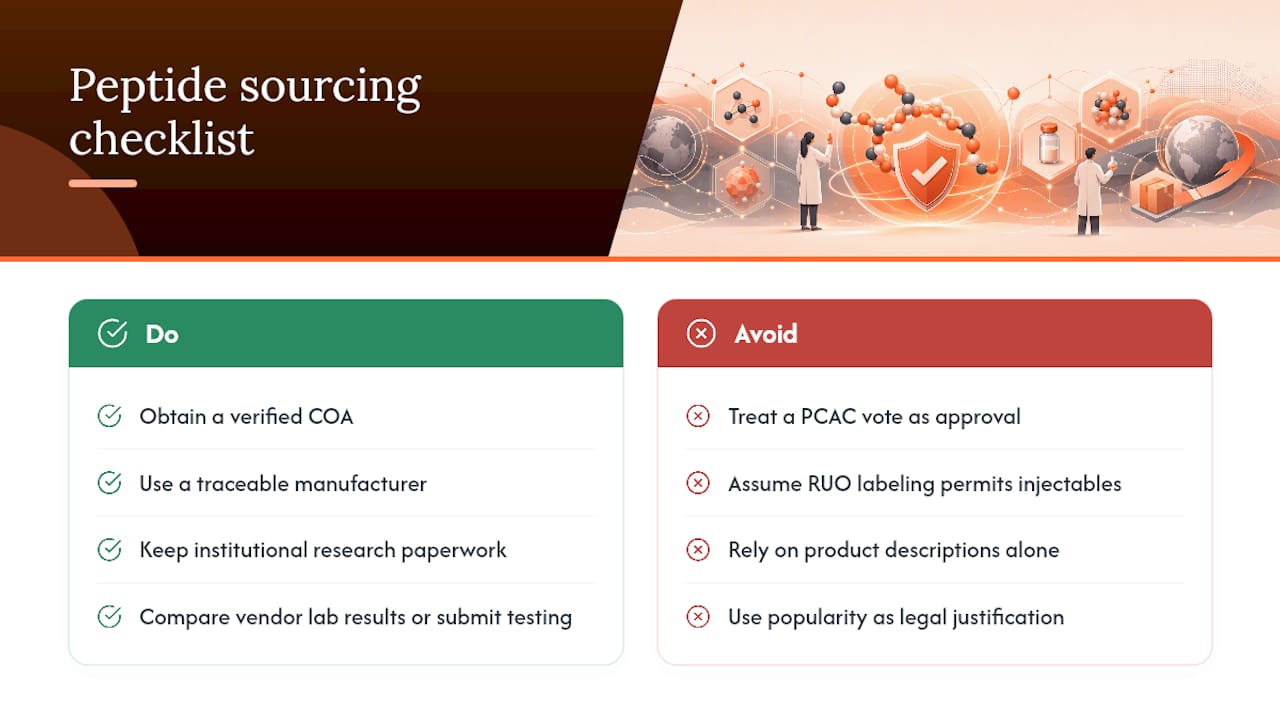
What the evidence actually supports is a slower, more boring conclusion: the legal test hasn’t moved. Intended use still drives the drug definition, RUO labeling still doesn’t shield injectables, and enforcement is getting more consistent, not less. Conventional advice tends to focus on whether a peptide is “popular” or “widely used,” which is a business question, not a legal one. It tells you nothing about whether your county’s medical board is about to open a file.
If you’re sourcing peptides for legitimate research, prioritize documentation over convenience: a verified COA, a traceable manufacturer, and institutional paperwork that actually says what you’re doing. That combination won’t make an unapproved peptide legal for human treatment, but it will put you on defensible ground if anyone ever asks.
— Ross
Peptide Vendor Reviews compares peptide vendors by lab-verified purity so researchers can check a supplier’s HPLC and mass spectrometry results before ordering, rather than relying on a product description alone. If you’re evaluating where to source a specific compound, compare peptide vendor lab results side by side, or submit a sample for independent testing if you already hold inventory and want an unbiased purity check.
This article is general information, not a substitute for advice from a qualified lawyer. Consult a qualified legal professional about your own circumstances before acting on anything here.