Researchers: 3 Checks to Trust a Peptide COA and Order Lab Testing
Written by Jian Wang, Founder & CEO · · Updated
A peptide Certificate of Analysis only deserves your trust when three things check out: the batch or lot number matches the vial and carries a recent test date, the HPLC chromatogram and mass spectrometry data confirm both purity and identity, and the numbers are independently verifiable through the testing lab itself. If any of those three fail, the next move is simple: look up the Report ID on the lab’s own portal, or contact the lab directly, before you use that peptide for anything that matters.
TL;DR:
- Always verify that the batch or lot number and test date on the COA match the vial and are recent before trusting any peptide lot.
- Confirm that the lab-hosted portal search results exactly match the COA details, especially for purity, identity, and net content.
- Watch for signs of a fake COA, such as no named lab, outdated data, inconsistent formatting, or missing method details.
- Independent testing is necessary when the peptide is for critical experiments, especially if the COA is outdated, incomplete, or unverifiable.
- Reliable vendors respond promptly to verification inquiries and provide batch-specific records, which reflect their operational trustworthiness.
Table of Contents
- What HPLC, MS, and Net Content Actually Tell You
- How Do You Independently Verify a COA?
- What Are the Warning Signs of a Fake or Misleading COA?
- When Should You Order Independent Peptide Testing?
- What Technical Details Should a Trustworthy COA Include?
- Quick Checklist Before You Trust a Peptide COA
- How Peptide Vendor Reviews Supports Independent Peptide Verification
- Why Recordkeeping Matters More Than Perfect Chemistry
- Get an Independent Verification Through Peptide Vendor Reviews
- Sources
What HPLC, MS, and Net Content Actually Tell You
A COA is really three separate claims stacked on top of each other, and each one needs its own scrutiny. Conflating them is how researchers end up trusting a document that only answers one of the three questions that matter.
HPLC area-percent purity measures how much of the detected material at a given UV wavelength corresponds to your target peptide versus everything else eluting off the column. A real chromatogram shows a sharp, symmetrical main peak with a clearly labeled retention time, baseline separation from any shoulder peaks, and a stated column type, gradient, and detection wavelength. Most labs run detection at 214 nm, which is standard for peptide bonds but has a documented blind spot: UV-transparent impurities can pass through undetected unless the lab also reports a secondary wavelength or uses a PDA detector.
Mass spectrometry identity confirmation answers a completely different question: is this actually the peptide it claims to be, not just something clean. ESI-MS should report an observed mass that matches the theoretical molecular weight within a tight tolerance, usually a fraction of a percent. A COA that skips MS entirely is telling you the purity number could belong to the wrong sequence and nobody would know.
Net peptide content, expressed as mg per vial, is the number that determines whether your dosing math is even valid, and it’s mathematically distinct from purity percentage. A vial can report 99% HPLC purity and still be short-filled, because purity describes the ratio of peptide to detected impurities, not the absolute quantity present. This is exactly why demanding quantitative mass data alongside purity matters: vendors have been documented omitting mass content specifically because it can expose underfilled vials.
- HPLC purity tells you how clean the sample is, not what it is.
- MS tells you what it is, not how much is in the vial.
- Mass-per-vial (via AAA or mass-balance calculation) tells you how much you’re actually dosing.
A COA reporting only one of these three is a partial answer dressed up as a complete one.
How Do You Independently Verify a COA?
Verifying a peptide certificate of analysis takes about five minutes if the lab is legitimate, and it should become a habit for any batch you plan to actually use.
- Find the batch or lot number and the Report ID printed on the COA. These should also appear on the vial label or shipping insert. If either is missing, stop here. It’s not verifiable.
- Open a new browser tab and type the lab’s known URL manually. Do not scan a QR code printed on the vendor’s own packaging or COA page. Fabricated certificates frequently embed QR codes that redirect to lookalike verification sites built by the vendor, not the lab.
- Enter the Report ID or lot number into the lab’s own portal search. A legitimate testing lab maintains a searchable database precisely so customers can do this.
- Compare every field line by line: lot number, test date, HPLC purity percentage, MS observed mass, and column or method details. The lab-hosted version and the vendor-supplied PDF need to match exactly, not approximately.
- If the lookup fails or returns nothing, email the lab directly with the Report ID and ask for an official PDF sent from their own domain, not forwarded through the vendor.
If the batch can’t be confirmed through any of those steps, quarantine that batch, don’t use it for time-sensitive work, and consider ordering an independent lab test to settle the question. Document every email and portal screenshot; that record becomes useful if you need to dispute a purchase or warn colleagues.
Pro Tip: Save a screenshot of the lab’s verification page alongside the vendor’s COA in your lab notebook. Labs occasionally update or remove old records, and you’ll want proof of what the portal showed on the day you checked.
What Are the Warning Signs of a Fake or Misleading COA?
Most fraudulent or misleading certificates share a small set of tells, and once you’ve spotted a few, they become obvious on sight.
- No named lab or accreditation. A COA that says “tested in-house” or lists no testing facility at all is not third-party verification. It’s a marketing document.
- Missing or stale batch data. No lot number, or a test date well over a year old, means you can’t confirm the report matches what’s in your hand, and stability can shift meaningfully over that window.
- Purity without identity or quantity. A slick chromatogram image with an area-percent number but no MS data and no mg/vial figure is answering one question while dodging the two that matter more.
- Visual inconsistencies. Mismatched fonts, oddly cropped chromatogram images, or a logo that looks pasted onto a generic template are classic signs of a doctored PDF.
- QR codes pointing to unfamiliar domains. Always check where a QR code actually leads before scanning; a redirect to a domain that isn’t the lab’s own is a hard red flag.
- No method details anywhere. No column, no gradient, no detector wavelength, no instrument model. Credible labs include this because it’s how other scientists reproduce or challenge the result.
When Should You Order Independent Peptide Testing?
Vendor COAs are a starting point, not a final answer, and certain situations call for your own third-party verification regardless of how clean the paperwork looks.
Order independent testing when the experiment is critical enough that a dosing error would ruin weeks of work, when precise stoichiometry matters, or when anything about the vendor’s COA looks inconsistent, outdated, or unverifiable through the steps above.
The minimum panel worth requesting mirrors what regulatory guidance already recommends for peptide reference materials: RP-HPLC purity with triplicate injections, ESI-MS for identity confirmation, and amino acid analysis (AAA) or a mass-balance calculation for actual mg/vial content. This orthogonal combination exists because each method has blind spots the others cover — HPLC alone can miss sequence errors, and MS alone says nothing about quantity.
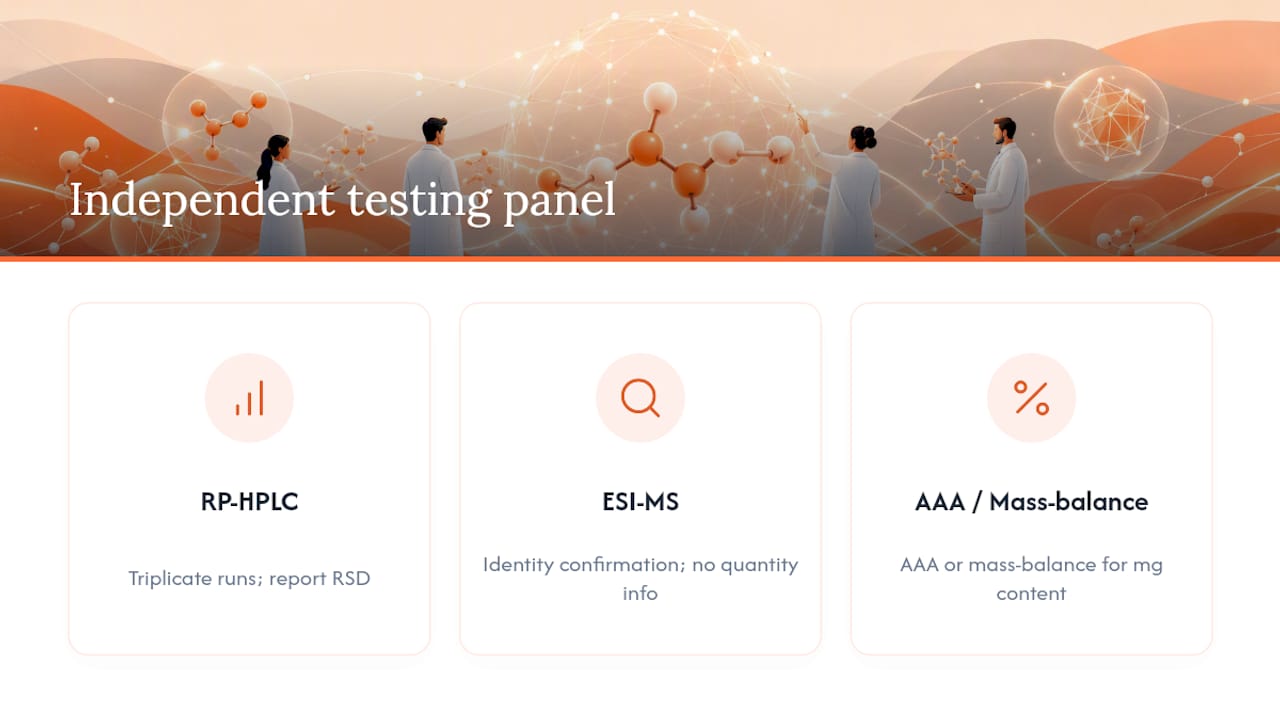
When you send a sample out, ask the lab for raw chromatogram files rather than just a summary PDF, request triplicate runs with reported relative standard deviation (RSD) on the main peak, and flag if the peptide was synthesized using TFA in its purification, since residual TFA can suppress ESI ionization and mask real impurities in the MS trace. Turnaround typically runs several business days to two weeks depending on the lab’s queue; treat any result that contradicts the vendor’s COA by more than a small margin as reason to stop using that batch.
What Technical Details Should a Trustworthy COA Include?
The best certificates read less like marketing collateral and more like a lab notebook entry, because that’s essentially what they are.
- Full method details: column type and dimensions, mobile phase gradient, detection wavelength, and instrument model or ID.
- Stated acceptance criteria: what purity or mass tolerance the lab considers a pass, not just a raw number with no context.
- Reference standard use: a note that the assigned purity relied on a characterized reference standard, consistent with the mass-balance approach USP describes for synthetic peptide value assignment.
- Repeatability data: triplicate injection results with RSD reported for the main peak, not a single run presented as definitive.
- MS observed vs. theoretical mass: both numbers side by side, so you can judge the match yourself instead of taking a pass/fail label on faith.
- Explicit mg/vial figure: stated plainly, not implied by a purity percentage alone.
Quick Checklist Before You Trust a Peptide COA
Run through this before using any new batch, especially from a vendor you haven’t ordered from before.
- Batch or lot number on the vial matches the COA exactly, and the test date is recent.
- The COA includes an actual chromatogram image, not just a summary purity number.
- MS identity data is present with observed and theoretical mass both listed.
- Net content (mg/vial) is stated, or a mass-balance statement explains how it was derived.
- The testing lab is named, and its Report ID is verifiable on the lab’s own portal.
| Check | Pass looks like | Fail means |
|---|---|---|
| Batch match | Lot number identical on vial and COA | Quarantine and re-verify |
| Chromatogram present | Labeled peak, method details shown | Request full report from lab |
| MS identity | Observed mass matches theoretical | Treat identity as unconfirmed |
| Net content | mg/vial explicitly stated | Assume possible short-fill |
| Lab verifiable | Report ID confirmed on lab portal | Do not use batch |
If any row fails, don’t split the difference. Quarantine the batch and pursue independent testing before it goes anywhere near a real experiment.
How Peptide Vendor Reviews Supports Independent Peptide Verification
This platform was built because COA-reading shouldn’t require a chemistry degree to catch a bad batch. The site aggregates independent HPLC and mass spectrometry data across more than 200 vendors, presenting batch-verified lab reports and purity rankings without picking favorites among the vendors it lists. For readers who want a second opinion on a specific vial rather than a vendor’s general reputation, the Test My Peptide Sample service exists precisely for that gap between a suspicious COA and a confirmed answer.
Why Recordkeeping Matters More Than Perfect Chemistry
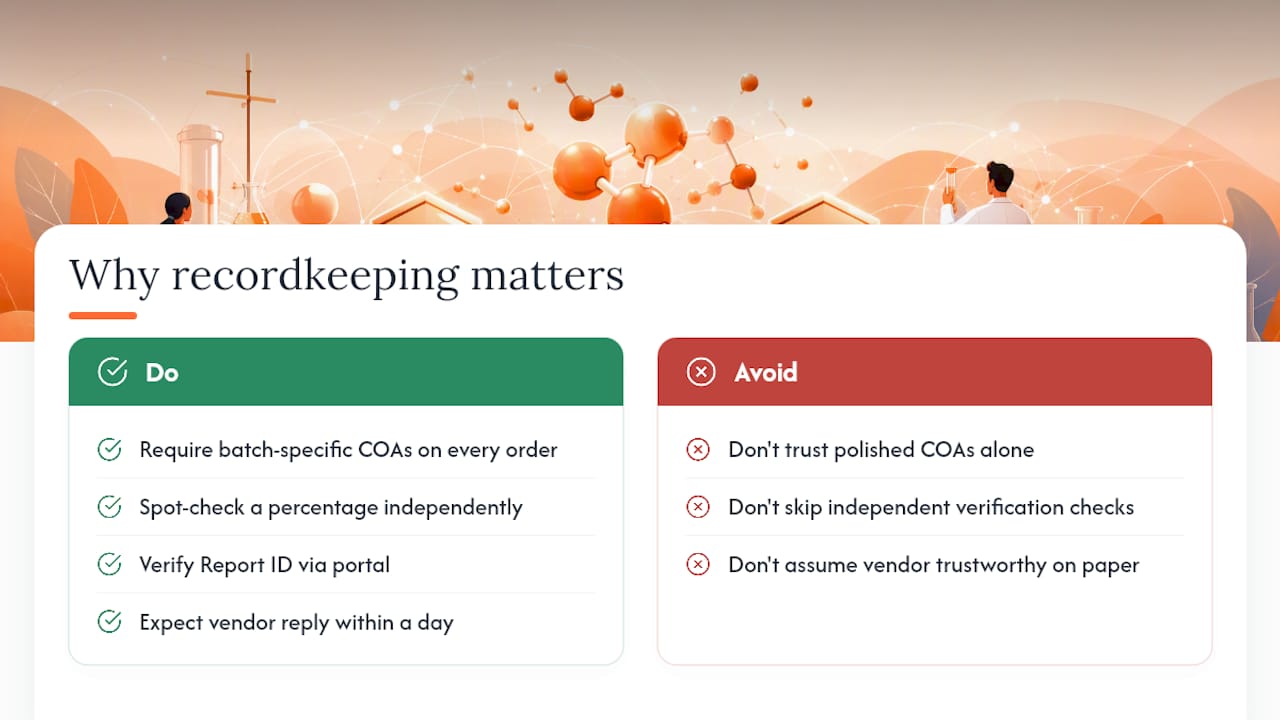
Reviewing COAs across dozens of vendors turns up the same pattern repeatedly: the certificates that look most polished aren’t always the ones that hold up under a portal lookup. What separates a trustworthy vendor from a risky one usually isn’t chemistry at all. It’s whether they answer an email about a Report ID within a day or go quiet.
A lab that keeps batch-specific records and responds promptly to verification questions is telling you something about its whole operation. If lab groups adopted one policy, it should be this: require batch-specific COAs on every order and spot-check a percentage of them independently, regardless of how trustworthy the vendor seems on paper.
— Ross
Get an Independent Verification Through Peptide Vendor Reviews
An advantage of this service is that instead of taking a vendor’s word or hunting down a lab’s verification portal yourself, you can order independent testing on the exact vial you’re holding and get HPLC, MS, and quantitative mass data back in one report. That closes the gap between “the COA looks fine” and “I know it’s fine” without you having to become your own analytical chemist.
The Test My Peptide Sample service delivers a chromatogram, mass spec confirmation, and net content assay when requested, run independently of whichever vendor sold you the peptide. It’s worth being clear about what this is and isn’t: it’s an independent verification service, not a regulatory certification, and it exists to give you a second data point when a vendor’s own paperwork leaves questions unanswered. If you’d rather compare vendor track records before you buy, Peptide Vendor Reviews’s vendor comparison page lays out lab-tested purity rankings across the market. To submit a sample or check current turnaround, visit the testing page directly and follow the submission instructions listed there.
Sources
For readers who want the underlying technical grounding rather than just the checklist, a few references stand above the rest. The USP guidance on reference standards for synthetic peptide therapeutics covers mass-balance value assignment in detail, and its companion PMC article on multi-lab integration explains why inter-lab variability drops when reference standards are used consistently.
- Reference standards to support quality of synthetic peptide therapeutics (USP)
- PubMed entry supporting quantitative analysis necessity
This article is general information, not a substitute for advice from a qualified doctor. Consult a qualified healthcare professional about your own circumstances before acting on anything here.