The way a peptide supplier asks you to pay decides two things: how much recourse you have if the order goes wrong, and what you can infer about the seller. A credit card gives you the strongest legal footing in the US. Zelle, Cash App, wire transfers and crypto give you the least. But no payment method tells you whether the vial contains what the label says. That takes independent lab data, which is what we compile at Peptide Vendor Reviews across thousands of third-party tests.
TL;DR
- Pay by credit card when a supplier offers it. US billing-error rules cover goods not delivered as agreed on credit cards, but not on most debit and app transfers.
- Zelle, Cash App, wires, gift cards and crypto are hard or impossible to reverse once sent. Treat a checkout that offers only these as a reason to slow down.
- Card acceptance shows a bank or processor reviewed the merchant. It says nothing about purity, identity or vial contents.
- Chargeback threats in a seller's terms are a warning sign about how it treats buyers.
- Check purity against independent lab results before you pay, not after.
Table of Contents
- Which payment methods peptide suppliers offer
- What each method protects, side by side
- Credit cards: the strongest position in the US
- Debit, ACH and bank transfers: narrower rights
- Zelle, Cash App, Venmo and PayPal
- Crypto, wires and gift cards
- If you are outside the US
- What a payment method says about the supplier
- Payment warning signs to watch for
- Check the vendor before you pay
- Where we fit in
- Our view on payments and proof
- FAQ
- Sources
Which payment methods peptide suppliers offer
Checkouts in this market tend to offer some mix of the following:
- Credit and debit cards, usually through a third-party processor.
- ACH or eCheck, a transfer pulled directly from your bank account.
- Peer-to-peer apps such as Zelle, Cash App and Venmo.
- PayPal and similar wallets.
- Cryptocurrency, wire transfers and, at the sketchier end, gift cards.
- Buy now, pay later installment plans at some stores.
Sellers that deal in research compounds are often treated as high-risk by banks and processors, so the options you see can change from one season to the next. A supplier that took cards last year may be ACH-only today. That is why a checkout screenshot from a forum post is a poor guide, and why you should look at what the checkout offers on the day you order.
What each method protects, side by side
Protection depends on the rails your money travels on, not on how reputable the website looks. This table summarizes the US position using the sources cited in the sections below.
| Method | Can you dispute a non-delivery or wrong item? | Notes |
|---|---|---|
| Credit card | Yes, as a billing error under Regulation Z | Written notice within 60 days of the statement showing the charge |
| Debit card | Limited | Regulation E error categories do not include goods not delivered as agreed |
| ACH / eCheck | Limited | Unauthorized transfers can be challenged, but a bad order is not an error category |
| Zelle, Cash App, Venmo | Mostly no | Network rules add some remedies, but you are not entitled to a reversal |
| PayPal | Sometimes | Purchase protection applies only if you choose the goods and services option |
| Wire, crypto, gift cards | Generally no | Like sending cash |
Credit cards: the strongest position in the US
Regulation Z, which implements the federal Truth in Lending rules, defines a billing error to include credit extended for property not delivered as agreed. According to Terminus Research's reading of 12 CFR 1026.13, you must give written notice within 60 days of the first statement showing the error. While the dispute is open, the card issuer may not collect the disputed amount or report it adversely to credit bureaus. Those duties bind the card issuer, not the seller, which matters later when we look at seller terms.
The FTC's guidance on buying from online marketplaces points the same way: credit cards carry legal protections if something goes wrong, while cryptocurrency is like sending cash and is generally unrecoverable once it is gone.
Worked example. You order three vials for a total of $210 on a credit card, and nothing arrives. You write to the card issuer within 60 days of the statement showing the charge, describe the non-delivery, and the issuer investigates. During that time you are not required to pay the $210. The same order paid by Cash App leaves you with a complaint to the seller and little else.
Debit, ACH and bank transfers: narrower rights
Debit cards and ACH payments fall under Regulation E. Under 12 CFR 1005.11, an error is limited to seven categories, such as an unauthorized transfer, an incorrect amount or an omission from a statement. Goods not delivered as agreed is not on the list. The notice deadline is 60 days after the statement first showing the error, and the bank must provisionally credit your account within 10 business days if its investigation runs longer.
In practice, that protects you if someone steals your card number. It does not protect you if you authorized a payment to a seller who never shipped. Card networks run their own voluntary dispute systems that sometimes help, but you cannot count on them the way you can on Regulation Z.
Zelle, Cash App, Venmo and PayPal
The National Consumer Law Center explains in its guidance on payment fraud that neither the Electronic Fund Transfer Act nor Nacha rules give you a right to stop or reverse consumer-initiated payments through Zelle, Venmo, PayPal, Cash App or wire transfers. Unauthorized transfers can be challenged. Payments you were tricked into authorizing generally cannot.
Private network rules sometimes add remedies. Zelle reimburses some imposter scams, and PayPal and Venmo offer purchase protection only when you select the goods and services option instead of friends and family. If a supplier asks you to send money as friends and family to "avoid fees," you have just given up the only protection those apps offer. The NCLC also advises reporting problems quickly to the payment provider and to law enforcement, including the FBI's IC3 at ic3.gov, with as much documentation as you can gather.
Crypto, wires and gift cards
These behave like cash. The FTC warns against gift cards, cryptocurrency and wire transfers when paying online sellers. A supplier that accepts only these methods has made a choice that leaves you with no recourse, whatever the reason behind it.
If you are outside the US
The pattern repeats elsewhere, with local rules. The UK Payment Systems Regulator explains in its consumer guidance on ways of paying that debit card chargebacks run on a voluntary scheme, that credit card purchases over £100 are covered by the Consumer Credit Act, and that bank transfers have no chargeback-style protection. New Zealand's Consumer Protection body advises paying by card and avoiding bank transfers and gift cards because money is easier to recover. Check your own country's rules before you rely on any of this, since the dispute rights above are specific to the US.
What a payment method says about the supplier
A supplier that takes cards has been accepted by an acquiring bank or processor, and that involves checks on the business's validity, creditworthiness and practices. Terminus Research calls this the one check on a storefront the storefront did not run on itself: certificates, badges and review scores all reach you through the seller, while the card field reaches you through a bank.
That is a real signal, and it has a ceiling. A creditworthiness check is not a laboratory. Card acceptance proves nothing about identity, purity or what is in the vial. High-risk processing also gets pulled from honest shops, so an honest storefront can end up with the same checkout as a dishonest one. A shop that loses its card processor is not automatically a bad shop, and a shop with a polished checkout is not automatically a good one. Our page on closed peptide vendors shows how often well-known names have disappeared.
The practical rule: use payment options to decide how much risk you carry if the order fails, and use lab results to decide whether to order at all.
Payment warning signs to watch for
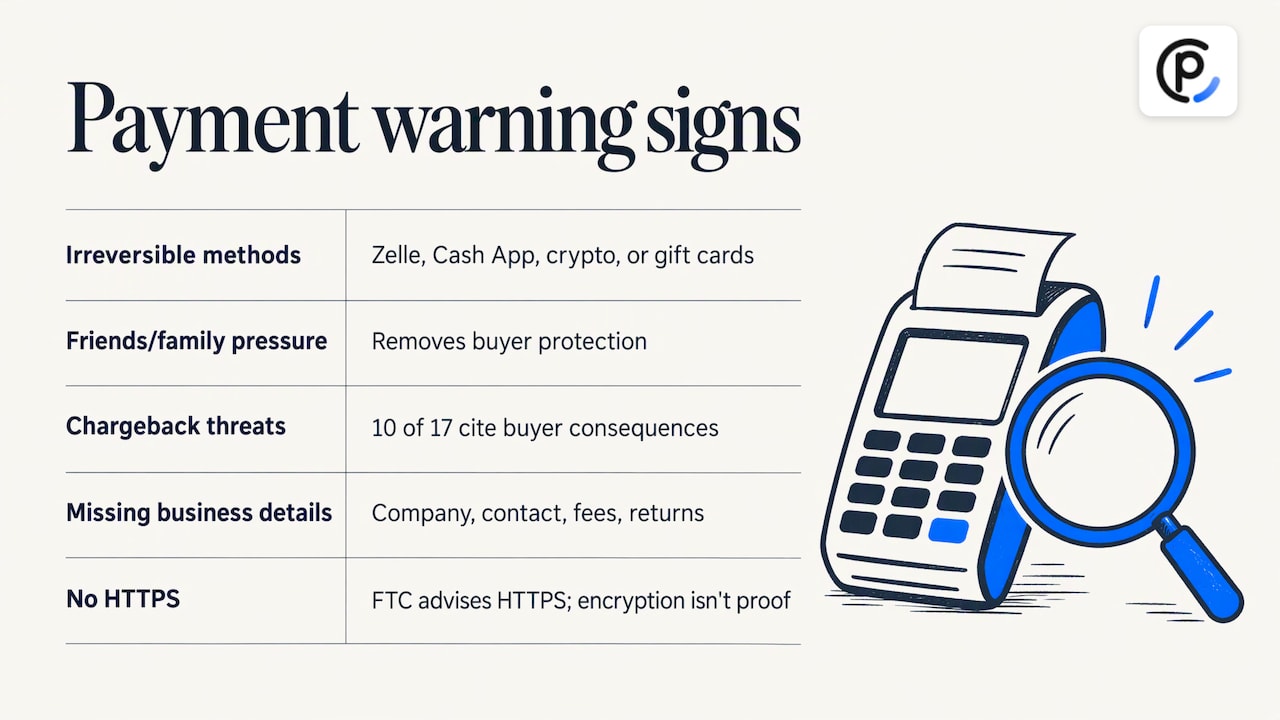
Only irreversible methods. A checkout that lists only Zelle, Cash App, crypto or gift cards leaves you carrying all the risk.
Pressure toward friends and family payments. This removes buyer protection on apps that otherwise offer it.
Chargeback threats in the terms. In a ledger of 126 supplier records read on September 14, 2026, Terminus Research found that 17 mention chargebacks at all, and in 10 of those the mention comes with a consequence for buyers who file one: a contested dispute, permanent ban, collections referral or credit-bureau report. Terminus reads that as a seller who has read Regulation Z and does not care for it, not as proof of fraud. Either way, you want to know before you pay.
Missing business details. The FTC recommends confirming contact information and reading terms, shipping fees and return policies in writing. The Quebec consumer protection office lists what a merchant must show before you complete an online purchase: company name and contact details, a detailed product description, the price with fees and taxes, payment terms, delivery time and the refund policy. That is a good yardstick for any checkout, wherever you live.
Payment page that is not https. The FTC advises checking that sign-in and payment pages use https, while noting that encryption alone does not prove a site is legitimate.
Check the vendor before you pay
Payment safety limits your financial loss. It does not tell you whether the peptide is what it claims to be. Do these checks first:
- Search the seller's name with "complaint" or "review." The FTC suggests comparing ratings across several sources, not one.
- Find independent lab results, not just a certificate on the seller's own site. Our seven checks for verifying a peptide vendor walk through this step by step.
- Compare the product you want. Independent purity results by peptide show how a given compound has tested across sellers.
- Read the terms. Look for refund, shipping and dispute language before you enter a card number.
- Pick the payment method last, and pick the most protected one on offer. If the only options are irreversible, that is information about the seller.
If you are comparing shipping terms for laboratory orders, this guide to shipping research peptides to a laboratory covers how consignments are handled. For a wider approach to choosing, see our guide on how to find peptide suppliers you can trust.
If you are a patient, speak with your doctor or pharmacist about any peptide you are considering using. Product quality and legal status are questions for a clinician, not for a checkout page.
Where we fit in
We compile independent lab tests across hundreds of peptide vendors and grade each vendor only on those results. Every score links to the original lab certificates, and our grades are not influenced by advertising or affiliate partnerships. You can browse the full vendor list ranked by lab tests, then compare price per milligram for the compound you want. Start with the grade, then look at which payment methods the vendor offers.

To see how we grade, read our methodology. Our site earns a commission when readers buy through some vendor links, and that does not change a vendor's grade.
Our view on payments and proof
Buyers often ask us whether a vendor that takes credit cards is safe. Our answer is that it is safer for your wallet, not necessarily safer for your body. A card gives you a legal route to dispute a charge. It does not give you a purity result.
That is why we start from lab tests. Payment methods are a signal a seller controls and a processor can withdraw. Independent test results are evidence that exists whatever the checkout looks like. Every grade on our site rests on those tests and links to the original certificate, so you can read the evidence yourself.
Our advice is a two-step habit: choose a vendor with strong lab results, then pay with the most protected method that vendor offers. Doing both costs a few minutes and removes most of the avoidable mistakes we see described by readers.
Ross
FAQ
What is the safest way to pay a peptide supplier?
A credit card is the safest option in the US, because Regulation Z treats goods not delivered as agreed as a billing error you can dispute within 60 days of the statement. Debit cards, ACH and payment apps offer much narrower recourse. Wires, crypto and gift cards generally offer none.
Does a supplier accepting credit cards mean its peptides are pure?
No. Card acceptance shows a bank or processor boarded the merchant after checking its validity and creditworthiness. It does not check identity, purity or vial contents. Use independent lab results to judge quality.
Is it a red flag if a peptide vendor only accepts Zelle, Cash App or crypto?
It is a reason to be careful. These methods are hard to reverse, so you would carry the whole risk if the order failed. Some honest shops lose card processing, so also check the vendor's lab results and reputation before deciding.
How do I check if a peptide vendor is legit before paying?
Search the vendor's name with "complaint" or "review," confirm its contact details, read its terms and refund policy, and look for independent lab tests tied to original certificates. Our verification guide lists seven checks you can run in a few minutes.
Sources
- Regulation E, 12 CFR Part 1005 Subpart A (eCFR)
- What a Supplier's Payment Methods Reveal (Terminus Research)
- Buying From an Online Marketplace (FTC)
- Helping Consumers Harmed by Payment Fraud (NCLC)
- Ways of paying (Payment Systems Regulator, UK)
- Check before you buy online (Consumer Protection, New Zealand)
- Consumer Tips: Before Buying Online (Office de la protection du consommateur, Quebec)